J S Savage on Fair-Play Mysteries, John Dickson Carr and 7 Deadly Sins
| Shelf | Book Reviews |
|---|---|
| Date in | |
| Readers | 644 |
J S Savage discusses the books that shaped his mysteries, his two detectives and the varied impossible crimes in his new collection, 7 Deadly Sins.

For J S Savage, the pleasure of a mystery lies in how its clues fit together. The Northern Irish author writes fair-play puzzles, including impossible crimes and locked-room cases, and his latest book, 7 Deadly Sins, gathers seven Inspector Graves stories. In this Five Books interview, Savage talks about the authors and titles he returns to, the novel he’s proudest to have begun with, and the different challenges a short mystery can hold.

Two detectives, two kinds of mystery
Savage has created two protagonists. Inspector Graves is a gruff, wise older detective who investigates impossible crimes in 1920s England, accompanied by Carver, an inexperienced constable. Penny Haylestone offers a different route into a puzzle: she’s a woman in her sixties who takes younger people under her wing, draws on her experience and finds herself caught up in locked-room murders.
That range gives Savage room to vary both the investigator and the mystery. Graves’s stories pair an established detective with a less experienced colleague; Penny’s combine her role as a mentor with the discovery of crimes she hadn’t set out to investigate. In both series, the central appeal is the fair-play challenge: readers are invited to follow the evidence and work out what happened.
A first encounter with Agatha Christie

There wasn’t one book that set Savage on the path to writing crime fiction. His introduction to the genre came through Agatha Christie’s The Mystery of the Blue Train. He picked it up while serving with the RAF in Kandahar, after finishing Tender Is the Night and looking for something lighter. Christie had called the mystery her worst, Savage says, but he enjoyed it and went on to read more of her work.
His own move into writing came from a different kind of spark: after reading a modern mystery, he wondered whether he could do better. He adds, with a nod to his own ambitions, “I’m a bit of a Brian Flynn.” The path from reader to writer began with curiosity, then became a test of whether he could build a satisfying puzzle himself.
The first book and the one he rates highest
Savage is particularly proud of The Mystery of Treefall Manor, his first book. He began without knowing whether he could write well or had a distinctive style, but kept going. He’s also pleased with how well the killer is concealed. Yet when asked which of his books he considers his best, he names The Riddle of the Ravens.
The distinction is telling: one title matters as the book that got him started, while the other represents the work he rates most highly. Readers curious about his development can follow that progression through his bibliography, which also includes Sun, Sea and Murder.
A model of clever construction

Asked to recommend a crime novel everyone should read, Savage chooses John Dickson Carr’s The Black Spectacles. He admires the way Carr makes a simple plot seem complex, and describes the book as a deftly constructed story about perception, memory and lies. His praise comes with one playful reservation: readers can ignore “the ridiculous car scene.”
His favourite non-crime novel is The Lord of the Rings. Savage says he didn’t expect to be drawn to a story of wizards, orcs and talking trees, but was won over by the book. It’s among the few titles he’s read twice, alongside Christie’s The ABC Murders, Hercule Poirot’s Christmas and The Murder Of Roger Ackroyd.
Seven stories, several kinds of puzzle
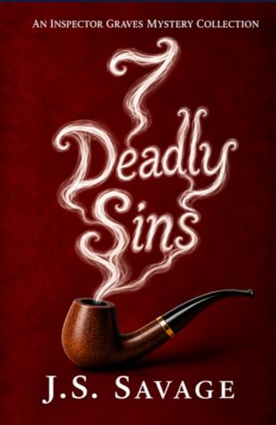
7 Deadly Sins is Savage’s new Inspector Graves collection. Though it contains seven stories, he describes it as novel-length, with a broad mix of plots and ideas. Four stories feature impossible crimes, including two locked-room mysteries. Savage says he set out to challenge himself, and considers the collection among his best work.
One particular test was writing a fair-play serial-killer mystery in short-story form, a task he says is difficult even across a full novel. The collection also shifts the detective’s role from story to story. In The 38 Steps, Graves is in Paris in what Savage calls “a bit of an inverted mystery.” In A Three-Tea Problem, Carver has already done the investigative legwork, leaving Graves to solve the case as an armchair detective.
For readers new to Graves, Savage sees the collection as a suitable starting point: its stories offer a range of puzzle types while keeping the detective at the centre. The interviewer, who had read six of the seven stories at the time of writing, praised them as carefully built mini-mysteries and said Savage’s affection for classic crime fiction comes through in his work. The collection’s variety is a good invitation to see how many different shapes a fair-play puzzle can take.