Raymond Santana’s Illustrated Memoir Pushing Hope Traces Survival Through Art and Creativity
| Shelf | Book Reviews |
|---|---|
| Date in | |
| Readers | 947 |
Raymond Santana’s illustrated memoir follows his wrongful conviction, release and creative work, using bright artwork to tell a personal story of hope.

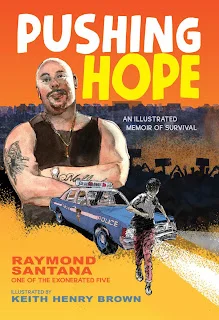
Raymond Santana’s Pushing Hope: An Illustrated Memoir of Survival, created with artist Keith Henry Brown, tells a deeply personal story through images as much as words. Its focus is Santana’s experience: a teenager drawn to Harlem’s art and fashion scene, a young man whose life was interrupted by a wrongful conviction, and an adult who returned to creativity as he rebuilt after release. The book’s bright, punchy illustrations give that account a distinctive form, while its lean text keeps the emphasis on memory, feeling and resilience.
Pushing Hope: An Illustrated Memoir of Survival by Raymond Santana and Keith Henry Brown runs 288 pages and is classified as biography and graphic novel. Calkins Creek published it in 2025; the listed price is $18. The review recommends it for high school and adult readers, though its appeal is described as selective.
A personal account told in pictures
Santana moved from the Bronx to Harlem in 1989, when he was 14. The new surroundings introduced him to an art and fashion scene he found fresh and inspiring. He writes about adjusting to the change and spending time with friends. Those early details establish the young person at the center of the memoir before the account turns to April 19, 1989, when Santana was arrested after spending time with friends near Central Park.
The memoir recounts a violent, prolonged interrogation and the wrongful conviction of Santana for rape and assault. Those events anchor the book, but they aren’t its only subject. Santana also describes his adjustment after release, later visits to prison, his exoneration in 2002 and the creation of Park and Madison NYC, his fashion brand with Rasheed Young. This wider scope connects the events of his youth to the years that followed, including his efforts to build a creative life.
The reviewer describes the book as moving and powerful, and points to its unusually light use of text. Some spreads give a single sentence room to breathe; others rely on a full illustration. Brown’s art is described as bright, distinctive and punchy, with an energy the reviewer sees as fitting Santana’s clothing line. That visual approach makes the book’s pacing part of its storytelling: readers encounter key moments through images and short passages rather than through long stretches of explanation.
What the memoir offers young readers
Pushing Hope can introduce readers who don’t know about the Exonerated 5 to Santana’s individual experience. The reviewer is clear about the limit: this memoir isn’t a comprehensive account of the wider events or a detailed examination of their legal dimensions. Its center of gravity is Santana’s life and his response to what happened. Readers seeking a broad historical overview will need another source alongside it; readers interested in one person’s experience will find a more intimate entry point.
The book’s stated emphasis on hope and creativity gives the memoir a particular appeal for high school collections. Its account follows severe obstacles, but the review highlights the role of creative work in Santana’s life rather than presenting the memoir as a guide to the full history of the case. Santana’s closing words, quoted on page 276, describe the aims as “To never give up. To motivate. To inspire.” The line offers a concise expression of the book’s outlook, while the illustrated format makes that outlook accessible to readers who may respond more readily to images than to dense prose.
The review also identifies Santana as Afro-Latino and gives content guidance for selectors and readers: one swear word and two uses of “f”; mentions of rape and fondling breasts, along with brief non-sexual rear nudity; and discussions of violence during the interrogation. The book is rated R for language and PG-13 for mature content and violence. Those details matter for school and library collections, where an illustrated memoir’s form may invite younger readers even as its subject calls for thoughtful placement.
A focused recommendation
For librarians choosing memoirs, the distinction between personal testimony and broad coverage is central to this recommendation. Pushing Hope offers a visually led account of Santana’s memories, the disruption of his teenage life and the creative work that became part of his later story. It doesn’t attempt to supply every background detail. Its value, as the reviewer sees it, lies in the combination of an individual perspective, compact text and expressive art.
That makes the book a considered choice for high school and adult readers interested in illustrated biography, memoir and stories of survival. The strongest reason to pick it up is its particular point of view: Santana’s account links his early interest in art and fashion with a later effort to shape a life through creativity. For readers who want a fuller account of the wider events, it can sit beside broader coverage; on its own terms, it offers a focused and visually memorable memoir.
Reviewed by E. Powell, Junior High Librarian.