Jean Craighead George’s The Talking Earth Brings Science and Seminole Tradition Together
| Shelf | Publishing Industry |
|---|---|
| Date in | |
| Readers | 849 |
Billie Wind’s Everglades survival journey reshapes her ideas about science, nature and Seminole stories in Jean Craighead George’s 1983 novel.

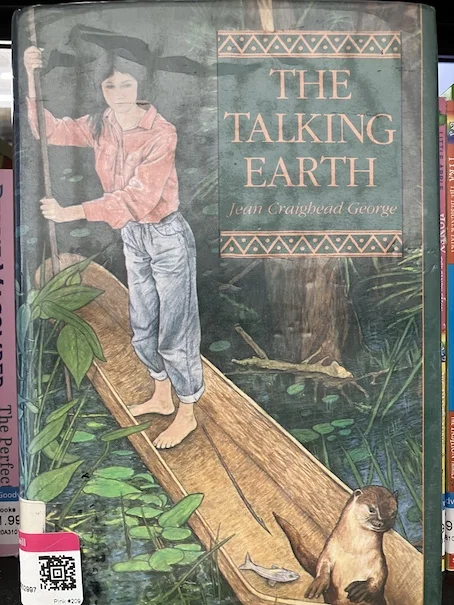
Jean Craighead George’s The Talking Earth puts a sharp, practical young reader of the natural world in a place where facts alone don’t tell the whole story. Billie Wind, a Seminole girl in Florida, begins the 1983 novel convinced that her people’s stories about talking animals and nature spirits are only legends. A forced journey into the Everglades tests that certainty through hunger, fire, unexpected animal companions and discoveries tied to her ancestors.
The journey begins at home, before Billie has so much as launched her boat. Her older sister, Mary, reports her doubts to the tribal elders. Many of the elders are relatives, including Billie’s uncles, and they ask what punishment she thinks would be fair. Billie assumes they’ll dismiss her suggestion as ridiculous: send her into the Everglades alone until she finds animals that talk. Instead, they accept it and prepare her to go.
Billie is angry, despite having proposed the trip. She asks Mary why she made the report. Mary says Billie has become too scientific since starting school at the Kennedy Space Center, and that she’ll need more than science to lead a family wisely one day. Billie, who trusts direct evidence and practical answers, doesn’t share her sister’s confidence in the old stories. That disagreement gives the novel its central tension: whether knowledge of the world comes only from what can be measured, or also from attention to inherited stories and living things.
Two ways of reading the world
Billie’s outlook reflects her family as well as her schooling. Her father works for the Kennedy Space Center, and she and her brother attend its modern school. Space travel fascinates her because she believes people may eventually need another planet. She also thinks about the dangers of nuclear war and environmental damage, concerns that place her firmly in the era when the book was written. Her mother is practical, too: as Billie leaves, she equips her with food and useful tools. Her uncle offers a blessing.
Mary has chosen a different path. She hasn’t attended the space center school and is deeply connected to Seminole traditions and stories. Where Billie looks to science, technology and what the future might hold among the stars, Mary turns to the past and to her people’s relationship with the Earth. George makes this divide personal rather than abstract. Billie isn’t careless or foolish; she wants reliable answers. But the wilderness soon gives her questions that require observation, patience and an openness to forms of knowledge she has dismissed.
At first, she applies a literal standard to the idea of talking animals. Birds call around her, but she decides their sounds don’t count: she can imitate an owl, yet it doesn’t answer in human speech. She uses what she knows about the terrain to locate a cave and wonders whether that, too, might be the Earth speaking. Then animals flee, and smoke gives her a plain answer. A wildfire is spreading.
Billie knows she can’t paddle fast enough to outrun it. She wets herself as best she can and takes shelter in the cave. There, the danger makes her scientific understanding useful. She knows that fires can clear underbrush and that ordinary wildfires don’t usually burn hot enough to destroy trees. She also believes that clearing underbrush to prevent fires can have the opposite effect, leaving fires to burn hotter. The knowledge helps her understand what she’s facing, though it can’t make the situation safe. She wonders whether her family will search for her, but they may think she went another way.
A cave connects survival and history
While waiting for the fire to pass, Billie finds a clay bowl. She first assumes the cave was used for burials, then notices that the bowl is intact; she believes a vessel placed in a burial would have been broken. Further exploration suggests the cave was once a home. She finds other artifacts and traces of a bed, perhaps belonging to a distant ancestor. Carved steps in the stone add to the evidence. Billie imagines returning with her uncle, Charlie Wind, and possibly an archaeologist to investigate.
For now, survival takes precedence over research. The ground outside remains too hot to cross, her food is running low, and she fears she could die before reaching home. A nearby pool offers a possible source of food: turtles and snakes have taken refuge there. Then a sound reminds her of Charlie’s calls, but the figure she sees is an otter in a hole. Billie befriends the young animal, catches fish from the pool and learns from the otter’s behavior that the water is deeper than she had thought. Fish, it seems, shelter in underground rivers and pools during fires. Billie wonders whether her ancestors shaped those waterways to make fish available to their people. More artifacts, including a forgotten medicine bundle, deepen the cave’s meaning.
The fire also unsettles Billie’s belief that the Earth is simply dying and that people will have to move elsewhere. Her father and the scientists around him seem right when she sees the destruction, but the burned land offers a complication: with trees gone, sunlight reaches places that were previously shaded, and new plants begin to grow. Nature, she discovers, can recover and adapt in ways she hadn’t expected. The book lets her scientific knowledge remain part of the picture while challenging her assumption that it is the only useful way to understand what she sees.
When Billie can finally leave, her boat has burned. She salvages what she can, including artifacts, and sets out to make her way home. She carves another boat and encounters further dangers and companionship along the route, including an orphaned panther cub and a turtle. The destruction of the island where the cave stood also has a human cause: development by white people. Billie’s experiences tie environmental loss to decisions made by people who may not understand the place they’re changing, or who value development over the natural and historical traces in their path.
Little by little, Billie learns to read animal behavior as a kind of communication. She watches, listens and interprets signs instead of waiting for speech in human language. Her growing connection with the Everglades doesn’t erase her interest in science. She still draws on ideas such as oxidation and air pressure, and sees archaeology as a way to learn how people lived in the past. What changes is how she puts kinds of knowledge together: scientific concepts, practical attention, ancestral stories and experience all help her make sense of the world.
A coming-of-age story with room for debate
In my view, the novel’s strongest thread is Billie’s gradual change from dismissal to curiosity. She doesn’t simply abandon her original beliefs when the Everglades prove difficult. Rather, her experience gives her reasons to reconsider what counts as evidence and communication. When she meets a Seminole boy who is also on a name quest, she recognizes that she believes in her people’s stories more than she had admitted. Explaining her understanding to someone with a similarly modern outlook helps her put that change into words.
Some Goodreads reviewers object to the book’s repeated criticism of white people and their treatment of the environment. I read that criticism as focused on specific harms: disrupting ecosystems through poorly understood interventions and damaging natural or archaeological places through development. The story’s example of clearing underbrush, which can make a later fire burn hotter, shows how well-meant action can cause damage when people don’t know enough about the environment. George, the author, came from a family of naturalists, and her concern about human disregard for nature is clear. The perspective belongs to the novel and its author; it shouldn’t be treated as a universal judgment on every reader or community.
Billie starts out looking to space as a possible answer to Earth’s problems. By the end, her attention has shifted toward caring for the home she already has. She no longer assumes there must be another planet just like Earth, and she sees that understanding the world can change what people value in it. For young readers drawn to survival stories, animal encounters and a thoughtful clash between scientific and traditional ways of knowing, The Talking Earth offers an adventure whose central discovery is as much about listening as it is about getting home.
The book is available to borrow and read for free online through Internet Archive, where readers can find multiple copies.
My Reaction
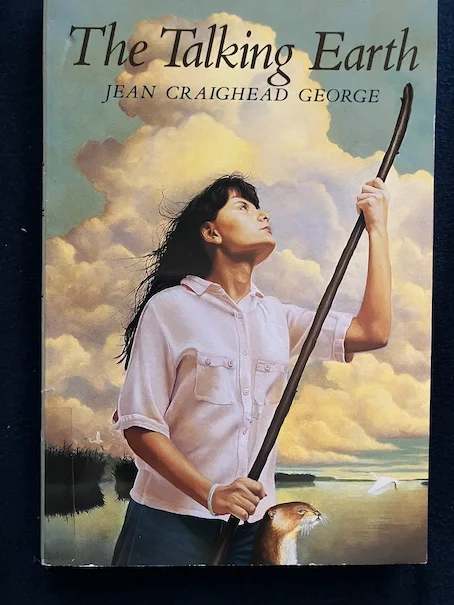
This is a marvelous blend of coming-of-age fiction and survival adventure. Billie’s practical instincts make her an engaging guide through the Everglades, and her changing view of the natural world gives the danger a purpose beyond simply getting her home.
I wasn’t persuaded by the argument that the book’s criticism amounts to a claim that white people ruin everything. Its attention stays on particular choices and their effects: actions taken without enough knowledge of local ecology, and development that erases parts of the natural world and its history. The underbrush example makes the first concern tangible; the loss of the cave island makes the second personal. George’s naturalist background helps explain why these issues matter to her, while Billie’s perspective gives the story its emotional force.
What I like most is that Billie doesn’t trade science for tradition. She keeps using what she knows, and her experiences add new ways to interpret the world around her. She learns that an animal can communicate without speaking as a person would, and that her people’s stories can carry meaning she had overlooked. That combination makes her journey feel earned. The novel’s closing insight is a lasting one: curiosity can lead beyond the search for another world and back toward a deeper understanding of this one.
Readers can also find other reviewers’ reactions on Goodreads and learn more about Jean Craighead George.