Pauline Hayton’s No Long Goodbyes Traces a Widow’s Journey Through Wartime Burma
| Shelf | Book Reviews |
|---|---|
| Date in | |
| Readers | 586 |
Pauline Hayton’s historical romance follows Kate Cavanagh from grief in England to danger and hard-won self-knowledge in Burma.

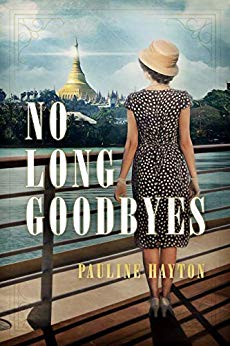
Pauline Hayton’s No Long Goodbyes finds its strongest footing when Kate Cavanagh’s private struggle meets the physical demands of Burma. A young widow carrying the grief of her son’s death and the hurt of a neglectful marriage, Kate leaves England in the 1940s hoping distance will help. Instead, a new country confronts her with unfamiliar relationships, harsh terrain and the danger of a war reaching Burma. The result is a historical romance whose deeper interest lies in Kate’s gradual recovery of trust and courage.
The setting gives that journey its particular texture. Kate encounters wild elephants, illness, insects and countryside that resists easy passage. These details make her relocation feel like more than a change of scenery: the landscape continually tests what she thinks she can manage. Jack Bellamy, handsome and drawn to Kate, brings the possibility of romance, while the danger around them raises the cost of the choices they make.
A setting that shapes the story
Hayton places the action against the familiar backdrop of World War II while directing attention to what was happening in Burma. That focus gives the novel a less common setting for historical romance and offers readers a view of the period beyond its better-known European events. The maps are a useful part of the book’s design, helping readers follow Kate’s route as she leaves Burma and understand the geography connected to Jack’s story.
The reviewer finds the descriptive work especially effective in the latter half. As Kate and her companions travel, mud, steep inclines and rough paths become immediate obstacles. Hunger, violence and disease add to the danger. The details create a grounded sense of effort and uncertainty, so the journey’s hardships register as more than a list of hazards. For readers who enjoy fiction that makes place central to its characters’ experience, this is one of the novel’s clearest strengths.
The early chapters, by comparison, can feel as if they are waiting for the story’s central crisis to arrive. Kate meets people and forms friendships, but some of those connections remain broadly sketched. Conversation and laughter are present, yet the reviewer feels readers aren’t always given enough to experience the closeness developing between characters. That slower opening may test the patience of readers looking for immediate emotional momentum.
Kate’s growth takes the lead
The review also points to moments when the characters’ reasons for acting aren’t clear enough. Jack’s interest in Kate and his decision to pursue a relationship are among the choices that could use more insight into his feelings and what he believes is at stake. Kate’s decision to join an amateur play raises a similar question: the action is clear, but the emotional calculation behind it is harder to see. More space for those inner turns might make the early relationships feel more convincing.
That distance narrows around the middle of the novel, as Kate journeys out of Burma. From that point, the narration connects more closely with her and her companions. The review describes the later characterization as heartfelt and complex, with Kate’s physical passage through difficult country accompanied by a more persuasive emotional one. She begins as someone shaped by loss and anxious about being abandoned or neglected; she ends better able to relate to others, though not presented as flawless or fully healed.
Jack’s two children also draw a specific reservation. At times, their dialogue makes them sound older than their stated ages, particularly the younger child. The mismatch reportedly fades as the story progresses. The reviewer also notes that misplaced commas and awkward wording can interrupt the reading, suggesting that editorial refinement would have helped the prose move more smoothly.
Romance with a broader emotional focus
Although the book is classified as historical romance, its emphasis may appeal just as strongly to readers of women’s fiction. Kate and Jack’s relationship matters, but the reviewer sees the larger arc in Kate’s changing relationship with herself and with other people. The romantic thread shares space with grief, resilience and the difficult work of allowing connection after neglect.
For readers choosing their next book, No Long Goodbyes looks best suited to those who enjoy a distinctive historical setting and a heroine whose development unfolds through both travel and hardship. Its opening can feel measured, and some character decisions need more explanation, but the detailed second half gives the Burma journey a vivid physical presence. Hayton’s story ultimately asks readers to follow Kate through unfamiliar country and watch as she finds a steadier way to meet what comes next.