Eternal Shadow by Trevor B. Williams: Alien Threat Meets Human Drama
| Shelf | Book Reviews |
|---|---|
| Date in | |
| Readers | 806 |
Trevor B. Williams pairs a looming extraterrestrial danger with hard science, suspense and the evolving bond between two SETI researchers.

Eternal Shadow works best when its vast danger and intimate human story move together. Trevor B. Williams gives readers an approaching alien spacecraft with the power to consume planets, then grounds that cosmic threat in the choices, expertise and changing relationship of two researchers trying to understand it.
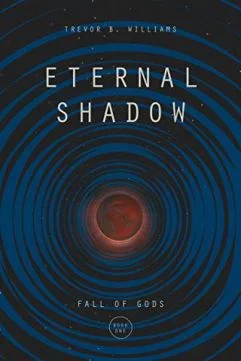
SETI scientists Jennifer Epstein and Samantha Monroe receive a signal from an extraterrestrial craft they name the Leviathan. Its path brings a stark discovery: it is consuming Pluto, Neptune and Uranus, and Earth is next. Humanity has ten years to find a way to survive. That deadline gives the novel its urgent drive, while the effort to interpret the signal keeps the mystery unfolding alongside the action.
A technical puzzle with momentum
The novel opens at speed and continues to raise questions as Jennifer and Sam learn more about the Leviathan. The reviewer's assessment is that the book's considerable length doesn't feel burdensome, because discoveries and developments keep arriving. The result is a story built around both a looming deadline and the steady work of making sense of an unknown intelligence.
Williams gives substantial space to the science behind space technology and communication. Artificial intelligence becomes a practical part of the effort to engage with the alien craft, and the reviewer finds that element convincing. This attention to mechanics gives the speculative premise a firm texture: the characters aren't simply confronted with a mysterious object; they must reason through how to study and communicate with it.
One vivid example is Hermes Two, a rover sent to explore the Leviathan. The craft's artificial intelligence reconfigures the rover so it can communicate with Earth. That idea links the novel's technical curiosity to its central problem: every new exchange may offer insight, but the characters are dealing with an intelligence whose purposes remain uncertain.
Readers who enjoy detailed explanations of theoretical science and space technology may find that level of attention especially rewarding. Those less familiar with the subject could find some passages dense, according to the reviewer, though the technical material doesn't derail the narrative. Williams seems most interested in making the imagined technology feel reasoned through, and the reviewer credits the book's research with lending plausibility to its premise.
Two researchers at the center
The scale of the threat could easily leave the people inside the story feeling small. Williams counters that by giving Jennifer and Sam's relationship room to develop across the years in which the danger approaches. Their changing bond supplies a personal thread through the larger account of humanity's response, and their thoughts, emotions and interactions receive attention alongside the science.
The reviewer's praise for the pair rests on that balance. Jennifer and Sam are presented as rounded protagonists, with reactions that feel as considered as the novel's technical details. Their relationship gives the story a human measure: the approaching catastrophe affects more than the fate of the planet; it shapes how these two people understand one another and face what lies ahead.
Williams also widens the frame to include humanity's response to the Leviathan. Political unrest and people convinced that the end is near complicate the effort to protect Earth. These pressures make the crisis social as well as scientific, adding friction to a race in which time is already limited. The novel's appeal, then, isn't confined to the mechanics of an alien encounter; it also considers how people behave when the future feels uncertain.
A science fiction story with room for other readers
The review describes Eternal Shadow as a science fiction novel with elements of romance, suspense, mystery and literary fiction. That mix helps explain why its central relationship matters as much as its planetary stakes. Readers looking primarily for action and a high-concept threat will find a clear engine in the Leviathan's approach, while those drawn to character development have Jennifer and Sam's evolving connection to follow.
Williams's approach makes the extraordinary feel close to home. The premise reaches across the solar system, yet its emotional focus stays with two researchers and the people confronting a shared danger. For readers who like science fiction that spends time on both the imagined technology and the people living with its consequences, Eternal Shadow offers a layered, suspenseful journey. Its central question—whether humanity can understand enough, quickly enough, to protect Earth—gives the story momentum through its final pages.