Jennifer A. Nielsen’s War Boats Follows a Young Sailor’s Determination
| Shelf | Publishing Industry |
|---|---|
| Date in | |
| Readers | 492 |
Cindy, a middle school librarian, recommends Jennifer A. Nielsen’s War Boats for readers drawn to determined young characters and historical fiction.

Arthur’s defining trait in Jennifer A. Nielsen’s War Boats is his refusal to stay where others put him. At 12, he has lied his way onto a merchant marine ship as Europe enters another war. When the SS Tairoa is captured and he becomes a prisoner of war, the experience doesn’t end his resolve to help. After his release, he runs away again, ready to find another ship and take risks in pursuit of a rescue mission at Dunkirk.
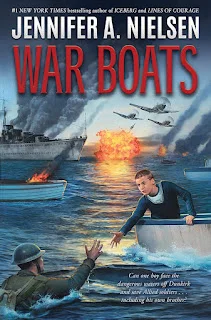
That determination gives the novel its central pull. Arthur’s choices are bold, sometimes reckless, and closely tied to the family tensions he carries with him. His father died trying to save the crew of his ship, while Arthur cannot stand his stepfather. Cindy, a middle school librarian with an MLS, sees those relationships as an important part of the story: what Arthur does at sea also changes the dynamics between him, his mother and his stepfather. The journey therefore has stakes at home as well as aboard ship.
A young character shaped by loss and conflict
The premise brings together two sources of pressure in Arthur’s life. His father’s death gives him a powerful example of sacrifice, while his difficult relationship with his stepfather leaves him restless at home. The source doesn’t spell out every reason behind Arthur’s decisions, but Cindy’s reading suggests that the family story remains active as the adventure moves from one ship to another. His actions aren’t simply a string of daring escapes; they also affect the people closest to him.
That connection may give readers a way into a wartime story that could otherwise seem distant. Arthur is a child trying to decide where he belongs and what he can do, even as events place him in situations he cannot control. His age makes the danger and uncertainty immediate, while his persistence keeps the narrative moving toward the next challenge.
Sea adventure, captivity and a rescue attempt
The story begins with Arthur’s false claim that gets him aboard a merchant marine vessel. The SS Tairoa is later hit and captured by the Germans, and Arthur endures grueling days as a prisoner of war. Once released, he doesn’t settle into safety. He runs away and joins another ship, then sets his sights on reaching soldiers trapped on the beach at Dunkirk. If he must steal a boat and cross the English Channel to try to help them, he is prepared to do it.
Those details establish a narrative built around escalating decisions and physical risk. Arthur moves from shipboard work to captivity, then back into danger by choice. The summary doesn’t reveal the outcome of his attempt, and Cindy’s comments focus instead on the quality that connects these episodes: Arthur keeps pushing forward. Readers who enjoy stories where a young protagonist has to act under pressure may find that drive especially appealing.
Cindy notes that the opening is a little slower than Nielsen’s usual pace. That’s useful context for readers who come to the book expecting the immediate speed of an action-led story. The early pages also have the work of establishing Arthur’s circumstances and family relationships, which, in Cindy’s view, give his later choices additional meaning. The story’s momentum comes from seeing how his determination develops alongside those ties.
A recommendation for middle school readers
Cindy gives War Boats an “ESSENTIAL” buying advisory for elementary and middle school readers, and says it “APPEALS TO: MANY.” She is particularly eager to offer it to students who have been enjoying historical fiction, especially boys, and notes that many already like Nielsen’s books. That makes the novel a natural candidate for school libraries and readers looking for an adventure centered on a young character rather than an adult account of the conflict.
The content guide rates the language and mature content G, with zero swear words and no use of the “f” word. Violence is rated PG, with war deaths mentioned. Those ratings help families and librarians judge whether the book suits a particular reader; they don’t replace a conversation about a child’s comfort with wartime peril and loss.
Arthur is described as white. The review offers no further character or plot details, so readers can approach the story without being given developments beyond its setup. Its strongest recommendation comes from Cindy’s response to Arthur’s determination and to the way his actions shape his family relationships.
Publication details
War Boats is by Jennifer A. Nielsen, runs 304 pages and is listed from Scholastic for March 2027 at $19. Cindy’s read is encouraging for readers who want historical fiction with a young protagonist facing danger, complicated family ties and a self-imposed mission. The slower opening may ask for patience, but Arthur’s choices give the story a clear thread to follow: each new challenge tests how far his resolve can carry him.