Ava Lehrman’s “Heart of Hearts” Traces the Many Meanings of the Heart
| Shelf | Publishing Industry |
|---|---|
| Date in | |
| Readers | 821 |
At William H. Hannon Library, Ava Lehrman’s exhibition connects heart imagery across religion, medicine, art and culture.
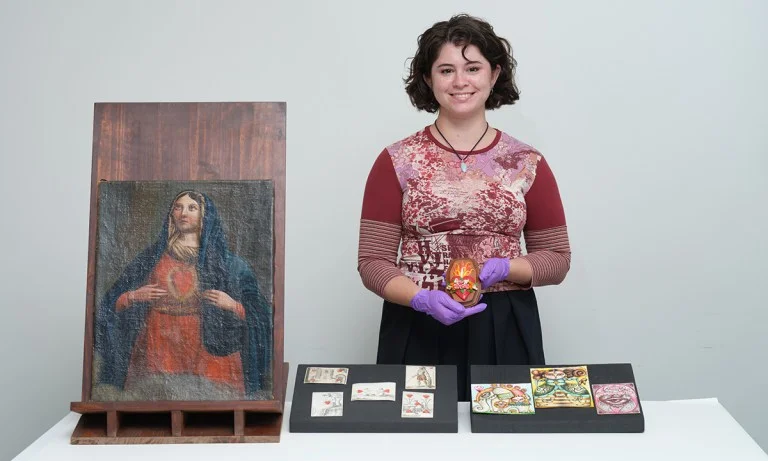
This post was written by Ava Lehrman, graduate intern at the William H. Hannon Library and student curator of the library’s Fall 2026 exhibition, “Heart of Hearts.”
A symbol with many lives
A heart can be a bodily organ, a religious emblem, a sign of affection or a source of fear. Ava Lehrman built “Heart of Hearts,” a Fall 2026 exhibition at the William H. Hannon Library, around those varied meanings. The display brings together objects from religion, medical history, art and culture, inviting visitors to consider what the heart represents across different times and traditions.
Lehrman began developing the exhibition during the 2025-26 school year, as a graduate intern with the library’s archives and special collections. The initial idea came up during her interview: supervisors suggested an exhibition focused on the heart, inspired by a couple of recent acquisitions featuring the organ. Lehrman was drawn to the subject and spent her first months searching the collections for ways artists and makers had represented it.
The variety surprised her. Heart imagery appeared in 17th century religious texts, modern artwork by Latina artist Maya Gonzalez and a miniature Japanese sculpture carved from ivory. These objects gave Lehrman a starting point, but she wanted to look beyond the examples already held by the library. Rare book catalogs and auction websites led her to further possibilities, including Cotta transformation playing cards and an early 19th century painting of the Immaculate Heart of Mary.
The library purchased these objects for the exhibition. Their addition gives “Heart of Hearts” a lasting connection to the collections: Lehrman’s research shaped not only the gallery display, but also what the library holds for future visitors and researchers.
Belief, memory and the objects in between
Religious meanings form one thread of the exhibition, but the heart’s symbolism doesn’t stop there. Lehrman sees it as a motif that shifts between the spiritual and the physical, and between emotions such as joy and fear. The title reflects her wish to get to the core of those meanings. She describes the display as an invitation to think about the heart, rather than a complete account of its history.
One object helps broaden the exhibition’s religious frame. Most of the artifacts come from the library’s special collections, but Lehrman also secured a loan from the Institute for Archaeological Studies collections. Caroline Sauvage, professor of archaeology in LMU’s Bellarmine College of Liberal Arts, shared a piece of linen from an Egyptian mummy’s wrappings after Lehrman explained that she hoped to include a perspective beyond the European material in the display.
The linen would have rested on the mummy’s chest. It bears a figure with outstretched wings, identified by Sauvage as Ma’at, the goddess of cosmic balance and justice. In ancient Egyptian belief, the gods weighed the hearts of the dead to determine whether they would be accepted into the afterlife. Placed alongside Christian beliefs about the heart, the linen gives visitors a way to consider how different religious traditions connect the heart with judgment, spiritual life and what follows death.
For Lehrman, some of the exhibition’s most rewarding moments came from linking objects with very different origins. A burning-heart motif appears in a modern Ecuadorian masapán sculpture depicting the Sacred Heart of Jesus, a 19th century Dutch love letter and an 18th century Japanese woodblock print depicting traditional Chinese medical teachings. The objects share a visual element, but they come from distinct settings and traditions. Seeing them together invites comparison without requiring visitors to assume that the image carries one fixed meaning.
Winged hearts recur across the display as well. Lehrman leaves it to visitors to decide whether these examples communicate the same idea. That open question suits an exhibition built around a symbol whose associations range from bodily function to devotion and affection. A repeated image can create a connection between objects; the differences in their context leave room for interpretation.
Visiting the exhibition
“Heart of Hearts” will be on display in the Terrance L. Mahan, S.J. gallery on library level 3, from Oct. 5, 2026 to March 5, 2027. An opening reception is scheduled for Wednesday, Oct. 7 at 5:30 p.m. The gallery is open from 9 a.m.–4 p.m. Monday through Friday.
Lehrman thanked LMU’s Department of English graduate program and the William H. Hannon Library’s archives and special collections team for the opportunity. She also acknowledged Karen Rapp, Caroline Sauvage, Eric Haruki Swanson and Robin Choudhury for their advice. The exhibition’s range of objects makes the heart a meeting point for art, belief, history and medicine, with visitors invited to bring their own interpretations to the gallery.
The post Student Curator Ava Lehrman on “Heart of Hearts” appeared first on LMU Library News.