LMU Honors Students Explore Rare Books and Special Collections
| Shelf | Publishing Industry |
|---|---|
| Date in | |
| Readers | 521 |
A hands-on William H. Hannon Library visit introduced 56 Honors students to rare materials, object analysis and research support.
This past month, 56 Loyola Marymount University Honors students got a close look at the William H. Hannon Library’s special collections, alongside an introduction to the people and services that can support their research. The visit paired practical guidance with direct work around rare materials, giving students a way to start asking questions of objects rather than simply viewing them behind glass.
The orientation had two parts. Student Engagement Librarian Ray Andrade opened with a welcome and an overview of the library’s collections, services and events. Students watched the “Welcome to the William H. Hannon Library” video, then shared what had caught their attention. Among the resources discussed were the library’s 24/7 Ask a Librarian live chat, which is monitored by a librarian, its vinyl records, upcoming special events and archives and special collections.
Andrade, an LMU alumnus, also encouraged students to treat librarians as research partners. Alongside meeting professors during office hours, students can request a research consultation when they begin a project. That advice linked the library’s broad range of services to the more focused work students would encounter in the second part of the visit.
Learning from objects
Andrade led the group to Level 3, where Head of Archives and Special Collections Cynthia Becht and University Archivist Liz Zepeda introduced a display of materials. The selection moved across eras and subjects, including contemporary Latinx art, couture fashion, 15th century medieval manuscripts and 20th century scrapbooks. That range gave students a chance to see how much the collections could offer across different interests and fields of study.

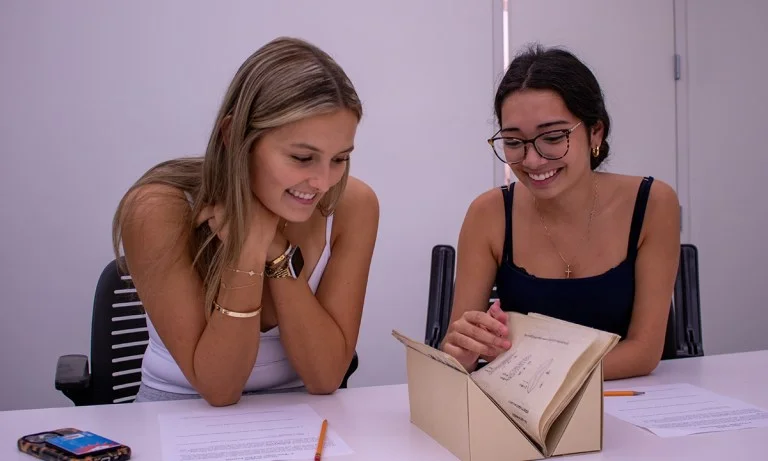
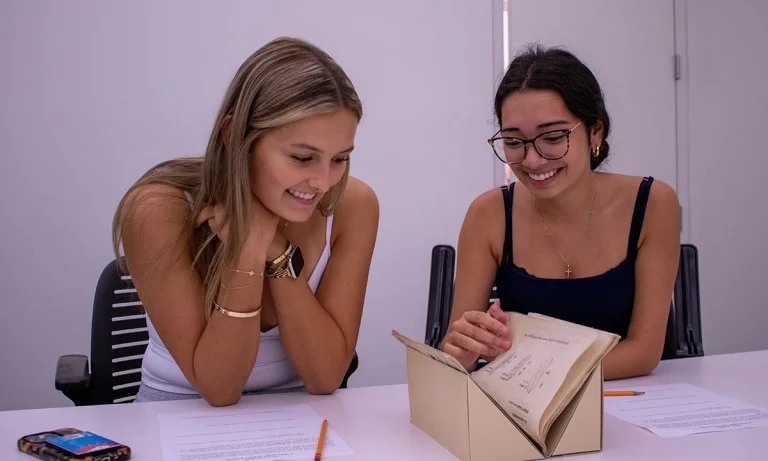
Becht and Zepeda organized students into pairs for an object analysis activity. Each team chose an item and used questions to guide its examination, drawing on approaches associated with archaeological analysis. Students considered what an object was, whether they could tell when it had been made, and who might have used it. They then presented their observations to the class and visited the other display stations.
The structure gave students a starting point for reading an unfamiliar object: notice its physical features, consider the context suggested by those details, and explain what remains uncertain. The exercise also put the materials in students’ hands as subjects for inquiry. As one participant later put it, “Seeing all of the primary sources firsthand was amazing, getting to see actual parts of history.” Another highlighted the value of learning “How to interpret and examine artifacts.”
A manuscript becomes a research project
At the close of the session, Becht and Zepeda invited students to return and explore whatever had sparked their curiosity. Becht shared the story of Michael Madrinkian, ’12, whose own interest in a manuscript grew into a substantial research project.
“Michael Madrinkian, ’12, encountered a 16th century English manuscript in one of his class visits to archives and special collections. Intrigued by the mysterious clues of its early provenance noted inside the book (“ … discovered in Errary [underground cellars] of Saint George’s Chapel, Windsor Castle”), Michael embarked on a detective hunt that resulted in his making a thorough analysis of The Rych Cheyne the subject of his senior thesis. Michael successfully approached both the Honors Program and the library with a request for funding to travel to England to seek its attributed early home at Windsor Castle. Embarking on the adventure, he was permitted entry into an area of the chapel usually kept off limits to visitors. Not only did Madrinkian walk the historical spaces that may have been where the manuscript was discovered, he also learned to read the challenging 16th century handwriting in the manuscript and won an Undergraduate Library Research Award that year for his deep dive into the mysteries of the book.”
Madrinkian’s experience shows how a collection item can lead well beyond an initial visit. A clue in the book’s provenance prompted questions about its earlier history; those questions became the focus of his senior thesis and a trip to England. His work included learning to read the manuscript’s 16th century handwriting, and he received an Undergraduate Library Research Award for his research. The account offers students a concrete example of how close looking can develop into sustained scholarship.
Students plan to return
After the sessions, Andrade asked students to complete a brief survey. All 56 participated, and 88% said they were “very satisfied” with the visit. When asked what was missing, many echoed one response: “Nothing! I was glad there was an artifact similar to every major.” The comments point to the value of a display broad enough to give students from different areas something to investigate.

Some students stayed after the formal sessions ended to continue talking with Becht and Zepeda about the objects they had examined and other materials in the collections. Others asked about arranging a return visit. That response suggests the orientation succeeded in doing more than presenting an overview: it gave students questions they wanted to pursue.
The archives and special collections are available by request to all students, faculty and staff, not only Honors students. Those interested in exploring the materials can make an appointment. For students beginning a research project, the visit’s clearest takeaway may be that an intriguing object, a careful question and a conversation with a librarian can be a productive place to start.