The Head Collector by Mark Griffin: A Forensic Psychologist Enters a Chilling New Series
| Shelf | Book Reviews |
|---|---|
| Date in | |
| Readers | 539 |
Mark Griffin’s The Head Collector pairs a troubled forensic psychologist with a tense serial predator case, building from measured psychological detail to a striking reveal.
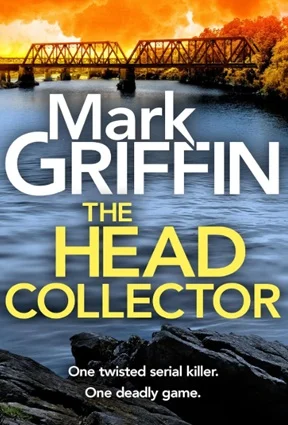
Mark Griffin’s The Head Collector gives its serial predator story an unusually strong psychological centre: Oswald Bennet, a forensic psychologist whose expertise is inseparable from a childhood shaped by violence. That history makes him an intriguing guide into a case that begins with a body discovered in a basement and quickly challenges the assumptions around it. The novel is the opening book in a new series, and its appeal lies as much in Bennet’s way of reading behaviour as in the mystery of who is responsible.
Bennet’s parents are both serving life sentences for trying to kill each other. He understands psychopathy in professional terms, but his family past leaves him carrying a more personal knowledge of what violence can do. When DI Anderson of the Portland Police in Maine asks for his advice about a disturbing scene, Bennet is pulled toward the sort of work he would rather avoid. His involvement puts what little stability he has at risk, and the danger soon becomes immediate.
The first victim is a devoted mother, found decapitated by a homemade guillotine. The death has been treated as a suicide, but Bennet sees signs of a highly organised predator. His assessment shifts the matter into a murder investigation. When a second headless body appears, the threat seems to be escalating. The deeper question, though, is whether the sequence is unfolding in response to events or following a plan laid down long ago.
Psychology drives the case
The novel’s most distinctive choice is its attention to the work of understanding a predator. Bennet is an academic, and he behaves like one: he observes, explains and takes time to show Anderson what patterns may suggest, as well as what they cannot prove. That gives the psychological material a place in the story beyond atmosphere. Readers see how his knowledge shapes the way the pair approach the evidence, while his own past complicates the distance he might otherwise keep.
Anderson has less page time than Bennet, yet the review finds enough depth in her character for her later scenes to carry emotional weight. Their professional partnership also gives Griffin a practical way to bring psychological ideas into the narrative. Bennet can offer a framework; Anderson has to work within the demands of the case. The exchange between those roles helps the book keep its focus on interpretation rather than turning the subject into a lecture.
That emphasis may suit readers who want a crime novel to examine how people think and act, not simply to catalogue gruesome details. The review describes the book as more interested in psychology than gore, and says it never relies on access to the predator’s prurient thoughts. Instead, the tension comes from Bennet’s deductions, the police response and the growing sense that the deaths may be connected by a larger design. For readers who prefer suspense built through character and inference, that restraint is a meaningful part of the book’s identity.
A slow build with a forceful finish
The first half moves at a measured pace. The reviewer found it difficult to accept that the first death could have been considered a suicide when Bennet identifies several signs pointing to murder. That gap between what he sees and the initial interpretation creates friction, though it may also test readers’ patience. The case takes time to gather momentum, and the early chapters spend space establishing Bennet’s methods and the unusual circumstances behind his involvement.
Once the second death occurs, the pace rises and carries the story toward what the reviewer calls an impressive ending. Griffin also uses a misdirection late in the book, and the reviewer says the eventual reveal remains effective despite that turn. The slow opening and faster second half therefore create a clear change in energy: the story first asks readers to sit with Bennet’s analysis, then presses harder as the stakes grow.
The review’s enthusiasm is personal and specific. The reviewer picked up the book after hearing about Griffin from Professor Mrs Puzzle Doctor, a fan of his earlier career as Trojan on Gladiators, and learning that he had written several well-received thrillers. Seeing The Head Collector offered on NetGalley as the start of a new series made it an appealing first read. The reviewer came away interested enough to follow the series, while acknowledging the pacing concern and the strain created by the initial suicide ruling.
The Head Collector is out today in ebook and physical form from Boldwood Books. The reviewer read an advance review copy provided through NetGalley. For readers choosing a new thriller, the book looks best suited to those who enjoy forensic psychology, a troubled central investigator and a mystery that builds toward a late reveal. Its central promise is not a parade of violent scenes, but a tense contest of interpretation—and the prospect of seeing how Bennet’s story develops in the books to come.
===END===