Adam O’Fallon Price’s Objects of Desire Finds Comedy in Creative Failure
| Shelf | Book Reviews |
|---|---|
| Date in | |
| Readers | 556 |
In Objects of Desire, Adam O’Fallon Price’s flawed characters chase artistic and personal success, then face the loneliness beneath their ambitions.
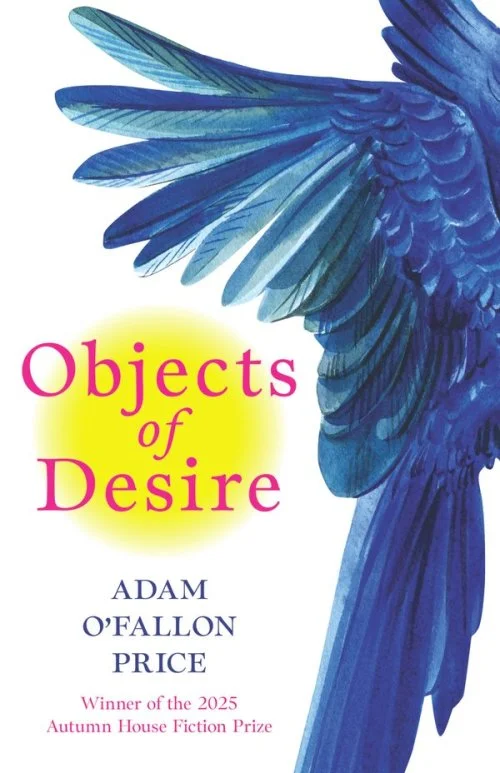
Adam O’Fallon Price’s Objects of Desire looks closely at the distance between what people hope to make of their lives and what they actually manage. Across this debut story collection, writers, athletes and men seeking affection carry big ambitions into middle age, often without a clear idea of what success would look like. Their disappointments can turn them boastful, dishonest or cruel. Price’s dry humor and attention to their loneliness make it possible to see the people beneath the bad behavior.
Many of the stories begin with a character who has tasted some success, only to find that it hasn’t delivered the life they imagined. The problem isn’t simply that their goals remain out of reach. They may have no firm way to measure whether they’ve achieved enough, and they’re reluctant to take responsibility when their efforts fall short. Instead, they reach for shortcuts, lash out or look for someone else to blame. Price gives this pattern room to be funny and uncomfortable at once.
Flawed people, recognizable needs
The collection’s characters can be difficult company. Mark, a student in “Dancing With Berg Hermly,” plagiarizes his schoolwork and would rather play an online game than study. Steven, the central figure in “Marrow,” considers withholding a bone marrow donation that could save his brother James. These men are selfish and often mean-spirited; neither story asks the reader to mistake their worst choices for admirable ones. Yet Price builds a case for their humanity through the needs they struggle to express. They are isolated, unhappy and hungry for connection, even when their behavior pushes people away.
Mark’s story brings that tension into focus. He is attracted to Ainsley Chelmsford, a boy in his biology class who also plays Animal Kingdom, the game Mark pursues obsessively. Mark’s interest in Ainsley mingles with his fixation on the shared hobby, giving his longing a small, telling everyday detail. Meanwhile, an act of academic dishonesty grows from a suggestion by his roommate. Mark first copies an old paper reluctantly, then carries the method into other classes. The gradual shift gives the story its account of how cheating can become easier once a person has crossed the first line.
Mark’s plagiarism remains a serious failing, but it isn’t the only thing shaping his choices. He is also trying to understand his queerness while living in a culture where he knows acceptance has broadened. That change leaves him able to put off confronting himself. As the story puts it, “while it had once seemed inevitable that he would have to come out of the closet, it no longer felt necessary.” Price lets this uncertainty make Mark more legible without excusing his conduct. Readers can disapprove of what he does and still recognize the isolation that surrounds him.
“Marrow” gives both brothers plenty of reason to grate. James mistreated Steven as a child and later married Hannah, Steven’s former wife. Steven, in turn, tries to manipulate Hannah and make use of her feelings. When James needs a transplant, Hannah asks Steven to donate, apparently aware that he still loves her. Steven sees the match as a way to stay close to her. The relationships are tangled with resentment and self-interest, and the story’s comedy sharpens rather than erases that mess.
Price’s timing can make an unpleasant scene unexpectedly funny. Hannah’s initial appeal for help ends with the revelation that Steven and James are brothers, a small turn that changes the shape of the exchange. The humor gives the characters a little breathing room. It also helps the story hold two thoughts together: these people hurt one another, and they remain more complicated than a list of their worst decisions.
Ambition, age and the measure of a life
In “Sandstorm,” Paul Wakeling has a comfortable home paid for by his wife, but his writing career has stalled. He teaches creative writing and bullies one of his students. The story captures the unease of someone whose creative work no longer seems to match what he once believed he could do. That portrait may prompt readers to wonder whether Price is drawing on his own experience. “Hoboken,” with Evan’s struggle with sobriety and his self-destructive behavior, raises a similar question about where the emotional truth of a story comes from. The collection doesn’t need those characters to be autobiographical. Their specificity makes them feel as if they might be.
The stories also place youthful possibility beside the compromises of age. In “A Last Chance in Whitefish,” Eugene is just beginning to make choices about his future as he drives through the West. He picks up a woman and an older man, Zell Jeffers, an artist known in some circles but not a household name. Jeffers’s partly successful career offers a counterpoint to Eugene’s open-ended prospects. Youth can feel full of promise, while a mature life invites a tally of what was and wasn’t accomplished. Neither position guarantees satisfaction.
That persistent gap between expectation and achievement gives the collection its melancholy center. Young characters can feel disappointed because they haven’t yet made anything of themselves; older ones may feel they have fallen short of the person they expected to become. Price’s people aren’t presented as celebrated winners. Their lives are shaped by modest results, frustrated desires and the stories they tell themselves about why things turned out this way. The book’s humor keeps that sadness from becoming solemn, while the characters’ failures keep their hopes from seeming easy to dismiss.
Objects of Desire returns to a question writers know well: what happens when the work we make doesn’t match the work we imagined? Price considers that problem through different kinds of ambition and different levels of self-deception. His stories suggest that circumstances can obstruct a person’s plans, but that people also contribute to their own disappointments. The collection may not offer a comforting measure of success. Its sharper invitation is to notice how often the desire to be admired, loved or accomplished gets tangled up with the choices that make those things harder to reach.
FICTION
Objects of Desire
By Adam O’Fallon Price
Autumn House Press
Published October 6, 2026

The post Stumbling Toward Our Dreams in “Objects of Desire” appeared first on Chicago Review of Books.
===