Yiyun Li on John Field, Percherette and the Hopes Behind Music Against the Night
| Shelf | Book Reviews |
|---|---|
| Date in | |
| Readers | 541 |
Yiyun Li discusses the musical lives of John Field and Percherette, the shape of her Nocturne Trilogy and why children deserve full lives on the page.

Before John Field and Percherette can face the losses that shape their lives, Yiyun Li wants readers to know them as children: ambitious, bewildered and already pursuing music in their own ways. That long attention to their beginnings anchors Music Against the Night, the first novel in Li’s Nocturne Trilogy. Set in the late eighteenth century, it follows the early lives of Field, the Irish virtuoso who invented the nocturne, and Percherette, an orphan of mixed descent born in French Pondicherry and a gifted musician herself.
The book opens with the deaths of its central figures, then looks back across the lives that brought them there. Its movement through time is carried by an omniscient narrator whose asides can be mischievous and intimate, placing the past and future beside the present action. Li sees that voice as a central character in its own right, and says it will continue through the trilogy.
Li spoke with Stephen Patrick Bell about the novel’s musical structure, the historical gaps that invited invention, children’s inner lives and the relationship between artistic ambition and survival. The conversation also touches on her memoir Things in Nature Merely Grow, in which she writes about the deaths of her sons, Vincent and James. The interview has been edited for clarity and length.

A narrator who carries the trilogy
Bell began by asking about the narrator’s role in the novel. Its third-person voice moves freely through time, adding context in parenthetical remarks without pausing the story. Bell described it as a wry companion to the reader, someone who can step out of the action for a brief exchange.
Li agreed that the narrator sounds like her. An editor who read an early draft had told her that the narrator was the book’s most important character, alongside John and Percherette. Li came to see the voice as a thread that could carry all three novels.
She’s drawn to the omniscient narrators of older fiction, which she finds more natural than many contemporary writers do. Charles Dickens, particularly in Bleak House, and Leo Tolstoy offer models of a narrator who can range across a story and address its world with confidence. Li enjoys making her own voice more mischievous than Tolstoy’s.
The trilogy’s starting point also grew from reading Tolstoy. Li and the late writer Edmund White had been reading Tolstoy’s three-volume autobiography together. In its early pages, Tolstoy recalls listening as a child to his mother play John Field on the piano. She died before Tolstoy turned two, and he remembered Field as “my mother’s master.”
Li had never heard of Field. Her first reaction was curiosity, not an immediate decision to write a novel. Even White, when she told him about the musician, wondered whether Field was English. He was Irish, though he became known as “The Englishman” during his adult life in Moscow.
What a thin biography left out
Li began researching Field through a short biography that devoted much of its space to musical analysis and scores. The biographical material was sparse, and its brief treatment of Percherette caught her attention. The book offered little account of how a young woman from Pondicherry came to live in Moscow. For Li, that blank was an invitation to imagine the journey and the life around it.
Once she considered both routes, the novel took shape around two people who had travelled far from home: Field from Dublin, through Bath and London, to Moscow; Percherette, as Li infers, from Pondicherry through France to Moscow. The documented outlines gave her a frame. Much of what happened within it, she says, had to be made up.
Two details from the biography stayed with her. One was a contemporary remark that Percherette was so flirtatious she might flirt with a walking stick if someone put a hat on it. Li found the comment striking, both for its oddness and for what it suggested about the way people described the young woman.
The second came from Field himself. On returning to London in 1832, he reportedly told English women that he had married his wife because she couldn’t afford the fee for his lessons, and that he had taken her up because he wanted something in return for teaching. Li brought both anecdotes into the novel, while treating the rest of the pair’s private history as material for fiction.
Percherette’s limited presence in the historical record became a creative opening. The biographer’s admission that “nobody knew” how she had made the journey gave Li a question the novel could pursue. The resulting character is not simply Field’s wife or a historical footnote. Li describes her as a prodigy in living as well as in music, a person who carries her force and appetite for experience wherever she goes.
Three stages in the lives of two musicians
Music Against the Night is the first of three books, and its opening draws on the knowledge that both protagonists will die and that their marriage will fail. Li wanted the reader to hold that ending in mind while spending time with the two children they once were. The sequence moves from childhood to marriage and mature artistic life, then to Field’s return to London.
The first novel gives considerable space to the pair growing up. Li says she needed readers to know them before they became adults, particularly because both are musical prodigies. Field’s childhood is shaped by the people who invest in his talent and expect him to become a great musician. Percherette’s path is different: music is something she chooses and pursues, even though she has no obligation to do so.
“Before hopelessness, there’s hope,” Li said of the choice to begin at the end and then return to the characters’ earlier years. She wants the reader to know where they end up, but also to accompany them in the hopeful period before their lives narrow under disappointment and loss. The childhood sections let them become more than the adults history has left behind.
In the second book, the characters will enter married life, developing their artistic ambitions as they confront difficulty in their relationship. The third will follow Field’s return to London and a tour of the continent that fails. By then, Frédéric Chopin’s popularity has changed the terms of Field’s reputation. Field invented the nocturne, but Chopin became the musician most associated with popularizing the form.
Li is also interested in the musicians who worked beyond the small group whose names dominate music history. She points to Muzio Clementi, who became a manufacturer, and to the many artists and tradespeople who composed, toured and helped make music a viable business. Their activity matters to her because it shows the infrastructure surrounding the celebrated musician.
Music’s growing public audience
For Li, the novel’s musical history offers a way to think about artistic work and the systems that sustain it. She isn’t interested in writing a historical novel as a display of period detail alone. The change she finds compelling is the emergence of music as a business and as an activity for a broader audience.
Before Field and Clementi’s time, Li says, music was closely tied to churches and aristocratic courts. Musicians served religious institutions and powerful households. Then public concerts, publishers, makers of instruments and a larger audience began to form a different kind of musical world.
Even the scenes in Jane Austen’s novels in which girls play the pianoforte point toward a whole network of work. Someone wrote the pieces they perform; someone printed the music; someone made the instrument. Li is interested in that system around the performance, not just in the composer whose name stays in view.
She sees an echo in publishing. Both fields involve artists, agents and businesspeople, along with the uncertain work of making a living from art. The specific conditions change, but Li thinks the relationship between creative ambition and the structures around it persists.
Clementi gives that idea a human shape. In Li’s novel, she gives him words about realizing he would never reach the top of the musical pyramid, where figures such as Mozart, Haydn and Beethoven stood. He can still understand himself as one of the people who made the structure possible. Li values that recognition: the work of artists and makers at different levels contributes to the whole, even when only a few become its most visible names.
Talent, choice and the cost of a calling
Bell asked whether Field’s drive for musical perfection offered a model for what a perfect novel might be. Li rejected the premise: she hadn’t set out to write a perfect book. Her interest lies in the different kinds of desire the two characters bring to music.
Percherette wants many things, with music only one of them. Field’s circumstances leave him with far fewer possible ways to live. His elders have marked him for a musical career, and he can’t read, do arithmetic or imagine another trade. Li sees his talent as both a gift and a burden: it opens a future for him while restricting the lives he can consider.
That constraint makes Field, in Li’s view, representative of many artists whose direction is set early by other people. The novel places him among other gifted young musicians, including George Pinto. Li likes Pinto as a character and is troubled by the judgments made about his sexuality. People in the story suggest he would be a great musician if he weren’t gay. Li sees a deeper connection: the emotional life that made Pinto vulnerable to those judgments was also part of what made him an artist.
These young musicians must find ways to be themselves while facing limits on how they can live and work. Li is drawn to the fatalism in the lives of prodigies: talent can put a child on a path before that child understands its cost. She mentions Mozart and Chopin, both of whom died young, and wonders what it means to have a life shaped so early by exceptional ability.
Percherette offers a counterpoint. She doesn’t have to become a musician, but she wants to. Her persistence comes from choice rather than an assigned destiny. Li loves her because she brings life into each place she enters, and because her ambition can’t be reduced to a single pursuit.
Children with lives of their own
Li’s patience with the protagonists’ childhoods reflects a broader conviction about how fiction treats children. She recalls another novelist advising her to give the young characters a few decisive experiences, then move quickly to their adult lives. Li found that approach dismissive. Children don’t need to be treated as unfinished adults whose lives begin to matter only after they grow up.
Children feel, notice and think intensely, Li says, but they may not yet have the language to express what is happening to them. A writer can give them words without making their thoughts sound artificially adult. The challenge is to respect the child’s way of seeing: the confusion, seriousness and partial understanding through which a young person makes sense of a world that often seems to have been arranged without explanation.
Percherette’s perspective captures that imbalance. As a child, she assumes the world is failing to make sense of itself to her; she doesn’t yet understand that she is the one who lacks the language to interpret it. Over time, she learns to see how the world communicates. Li finds that reversal useful for writing children, whose interpretations can be very different from an adult’s.
John’s younger sister, Grace Anne, is another character Li treasures. She is sharp and precocious, but her childhood view still brings a startling clarity. When the family leaves Dublin, Grace Anne cries and says, “Why are people so afraid to die? Growing up is more terrible than dying.” Li calls it the kind of thing a child can say because adults have forgotten what that feeling was like.
For Li, the novel gives children room to live in the present of their own stories. They aren’t only on their way to becoming adults; their fears and observations matter on their own terms.
Writing through grief and aspiration
Bell asked how Things in Nature Merely Grow influenced the novel, especially its treatment of time and attention. Li started writing the novel at the beginning of 2023. About a year later, her son James died. She had completed a draft before she began work on the memoir, then returned to revise the novel after writing it.
Ideas from the memoir found their way into the revision, Li says, though the books work differently. The novel thinks through its characters; the memoir draws on her own life. She sees the works as intertwined, but their forms and points of view remain distinct.
The characters’ long presence in her life has also helped her keep working. Li says five hours of writing may not produce good work, but sitting down to do it still makes something possible. A novel keeps its characters close for years, and she expects to live with John and Percherette through the next two books as well.
Percherette has been particularly sustaining. After her companion dies, she resolves to aspire to live—not in the literal sense of living forever, but in the sense of continuing to want life. Li says that aspiration supported her during the hardest periods of her own life.
Death is present throughout the novel: the story begins with the protagonists’ deaths, and the lives that begin are repeatedly set beside lives that have ended. Li points to Field’s family history, in which children died and parents reused names such as John, Robert and Grace. Death was part of ordinary family experience, rather than a distant abstraction.
Percherette’s response is to keep making music. She understands her music as an argument with finality. As long as she is alive, she can continue making that argument against what Li calls the dark thing: night.
The work of reaching
That image has a musical edge. Li says the nocturnes people often associate with Chopin can sound beautiful and calm, but night itself can be disturbing. Field’s nocturnes, she finds, contain moments of unease beneath their beauty. The novel’s title holds both qualities together: music can resist the darkness without pretending it has gone away.
The conversation also returns to the unfinished nature of artistic work. Bell mentions a teacher in the novel telling John that the music a person composes and plays will never match the music heard in the mind. Li recognizes that feeling. Artists may sense a distance between what they can make and what they imagine, but they still have to reach toward the imagined work.
Acknowledgments offer another image for that process. Li’s thanks to her friend Bridgid Hughes include the word “placeholder.” Hughes has been someone Li can give a half-formed thought to, even when it isn’t yet clear or sensible. She can hold the thought until Li is ready to explore it.
Hughes has also edited Li’s writing and used “placeholder line” for language that hasn’t yet expressed the thought behind it. Li sees writing as a series of replacements: the writer may not reach perfection, but can find a better placeholder than the one they had yesterday.
That idea suits a novel about two musicians with different relationships to their gifts. Field is driven toward a standard he can’t quite meet. Percherette’s ambition is broader, rooted in her desire to keep living and making art. Li’s account of both suggests that the reaching matters even when the work remains unfinished. Music Against the Night begins with endings, but its attention stays with the choices and hopes that make a life worth inhabiting.
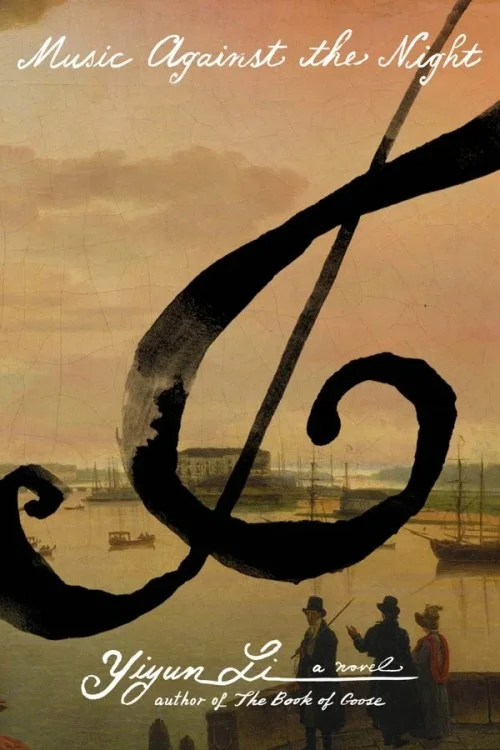
FICTION
by Yiyun Li
Farrar, Straus and Giroux
Published on October 13, 2026