Andromeda Diaz and the Reasonable Doubt: A Middle Grade Mystery About Looking Closer
| Shelf | Authors & Interviews |
|---|---|
| Date in | |
| Readers | 350 |
Emily Galvin Almanza’s middle grade mystery pairs two young sleuths with a school theft to investigate, supported by a classroom discussion guide.

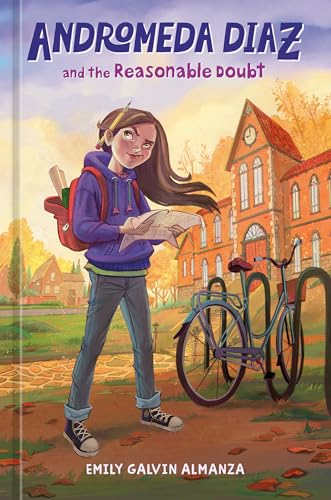
A gold watch turns a school mystery into a test of how carefully people judge one another in Andromeda Diaz and the Reasonable Doubt by Emily Galvin Almanza. Andromeda, known as Andy, is a fifth grader whose parents’ work has given her an early view of how a case is built. When her classmate Benji Jones is accused of taking the P.E. teacher’s watch, she trusts her sense of his character enough to ask whether the evidence tells the whole story.

The watch is found in Benji’s desk, a fact that makes the accusation difficult to dismiss. Andy and her best friend Danny begin gathering details about what happened, interviewing witnesses and looking for evidence that could clarify Benji’s role. Their inquiry puts them at odds with a principal, vice principal and security officer who believe they already know who took it. The tension comes from that gap: Andy sees a classmate she knows, while the adults see an apparent answer in the object found among his belongings.
A mystery that asks readers to weigh the evidence
The setup gives young readers an active part in the investigation. As Andy and Danny assemble information, readers can consider the same facts and make their own assessment of Benji’s guilt. That invitation helps the mystery do more than move from clue to clue: it asks how much confidence a single piece of evidence deserves, and what else needs to be understood before reaching a conclusion.
Andy’s family background informs her approach without making her a miniature version of her parents. She has absorbed ideas from hearing them talk about their work, and now she has a chance to put those lessons into practice among people she knows. Danny provides a close companion for the effort, giving the pair a youthful partnership at the center of the story. Their collaboration should appeal to readers who like mysteries in which the protagonists compare notes, pursue leads and revise their thinking as new details emerge.
The book also introduces the idea that people have rights in the justice system and that those rights must be respected when questions of innocence are being considered. The review describes this theme as part of what readers can learn from Andy’s investigation. For teachers and families, that creates a natural opening for conversation about fairness, evidence and why a confident accusation still deserves scrutiny. The story’s school setting makes those questions accessible to middle grade readers without requiring them to start with adult cases or specialized knowledge.
Structure and classroom possibilities
At 192 pages and 17 chapters, the book offers a compact mystery with frequent opportunities to pause and reconsider the clues. Chapter headings, often accompanied by a small image, hint at what comes next. The reviewer found those cues inviting enough to encourage “just one more chapter,” a useful quality for readers building independent reading habits or for a class reading in shorter sessions.
An educators’ discussion guide is available on the author’s website, with questions and activities designed to accompany the story. That resource may help teachers carry the investigation into group discussion: students can explain what they believe, identify which details influenced them and listen to classmates who read the clues differently. The mystery’s central uncertainty gives those conversations a clear focus, while Andy and Danny’s process offers a shared sequence of events to examine.
Another point of interest is the contrast between Andy’s parents. Although both work as lawyers, the reviewer notes that they handle their cases differently. That detail offers a reminder that professional roles don’t dictate a single style of working. It also broadens the book’s picture of Andy’s home life: she has learned from both parents, but each brings a distinct approach to the work that shapes her questions.
Publication details and the author
Andromeda Diaz and the Reasonable Doubt has a book birthday of September 8, 2026. The closing page hints that Andy may face another case, leaving room for a possible continuation. Readers who enjoy this first investigation may be glad to see the door left open, though the source does not confirm a sequel.
Emily Galvin Almanza is Co-Founder and Executive Director of Partners for Justice, a nonprofit that creates a collaborative model intended to empower public defenders nationwide. Before co-founding the organization, she worked with clients at the LA County Public Defender, Santa Clara County Public Defender, Bronx Defenders and the Stanford Three Strikes Project. She has said that everyone is entitled to equal justice and equal mercy.
Almanza graduated from Harvard University and Stanford Law School, where she received the Deborah Rhode Prize for public interest work. After her first year as a public defender, she clerked for the Honorable Thelton Henderson of the United States District Court for the Northern District of California. In 2017, the American Bar Association named her among its Top 40 Young Lawyers. Her writing has appeared in The Atlantic, The Washington Post, Newsweek, Teen Vogue and TIME. Crown published her book The Price of Mercy in February 2026. More information is available through her author website.
For readers looking for a middle grade mystery with a classroom-ready discussion guide, Andy and Danny’s search offers both a case to solve and questions worth carrying into conversation: What does the evidence show, what might be missing, and how should people respond when someone is accused?