Sally J. Pla’s ROWAN + GEMMA Brings Two Distinct Voices Together
| Shelf | Publishing Industry |
|---|---|
| Date in | |
| Readers | 438 |
Sally J. Pla’s October 2026 novel pairs a stuttering boy and an autistic, non-speaking girl in a tender story of friendship and family conflict.

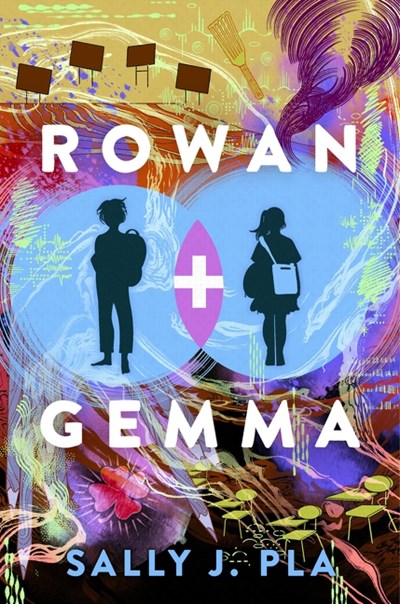
Two young people find a way to understand each other while the adults around them struggle to do the same. That gives Sally J. Pla’s ROWAN + GEMMA its warm center and its tension: Rowan and Gemma are beginning high school, building a new friendship, and trying to keep it intact amid a bitter feud between their mothers.
The novel is told through alternating viewpoints, giving each character room to express how they experience the same unfolding relationship. Rowan Monahan lives in the fictional town of Friendship Prairie with his parents. He stutters and processes information slowly, leading others to underestimate him. His cousin bullies him, and avoiding that cousin proves difficult. Rowan’s keen sense of how people ought to treat one another, though, gives him a perspective the adults in his life could stand to hear.
Gemma has recently moved to Friendship Prairie with her mother and her three older brothers, triplets who play football. She is autistic and non-speaking, and communicates using a tablet with a range of voices. Having been homeschooled, she faces the unfamiliar routines and social demands of high school. Pla lets Gemma’s way of communicating shape how readers meet her, while making clear that her thoughts and feelings are fully her own.
A friendship under pressure
Rowan and Gemma meet on their first day of classes and quickly connect. Their mothers, however, are locked in a personal conflict while competing for the same school board position. Accusations and personal attacks make the girls’ budding friendship harder to navigate. Rowan and Gemma fear that their mothers’ animosity could interfere, so they try to keep the connection private.
That setup gives the book a familiar romantic echo: the reviewer compares the pair’s predicament to a modern take on Romeo and Juliet. The comparison points to the pressure surrounding their relationship, rather than suggesting that the story abandons its own concerns. Here, the central question is how two young people can hold on to mutual respect when grown-ups bring their conflict into the children’s lives.
The reviewer finds the teens’ emotional understanding especially compelling. Rowan and Gemma often show more maturity than the adults around them, a reversal that lets the novel examine how children can recognize the harm in a feud even when its participants cannot step back from it. Their bond doesn’t make the family conflict disappear; it gives the story a way to consider whether connection might change how people behave.
Readers also get a closer look at communication through Gemma’s use of her tablet. That aspect of the story is a particular highlight for the reviewer, who also notes that October is AAC (Augmentative and Alternative Communication) Awareness Month. The book’s focus on Gemma’s communication can offer young readers a character whose voice comes through technology, and a chance to consider the many ways people express themselves.
Family, school and growing up
Gemma’s brothers add another strand to her experience of family life. The triplets are both supportive and amusing in their scenes with their younger sister. Their relationships aren’t presented as interchangeable: by the end, Gemma recognizes each brother’s individual character. That sibling dynamic gives her a source of support as she adjusts to a new town and a new school.
A teacher’s classroom discussion about media manipulation and artificial intelligence also stands out in the second half of the story. The reviewer describes the teacher’s approach as excellent and thinks readers can learn from it. Alongside the family drama, that episode brings a contemporary topic into the high school setting, inviting readers to think about how information is shaped and understood.
The romance stays gentle and appropriate for younger readers. The reviewer specifically recommends the book for children aged 10 and up, while describing its strongest fit as upper middle grade: Rowan and Gemma are just starting high school, and the story deals with family difficulties and an innocent first crush. Its brisk pace, helped by the back-and-forth narration, should suit readers who enjoy character-led stories that move between two perspectives.
The reviewer also notes that the ending is happy and that Rowan and Gemma become a catalyst for change among the adults. That outcome offers a hopeful payoff to the tension without requiring readers to choose a side in the mothers’ dispute. For parents weighing the romance for a younger reader, the review describes the first relationship as suitable for a 10-year-old.
About Sally J. Pla
Pla is an award-winning author whose books for young readers often center neurodivergent characters. She has spoken about drawing on her experience as a late-diagnosed autistic person, and her work is known for portraying characters who perceive and navigate the world differently.
Her books include The Fire, The Water, and Maudie McGinn, which received the 2024 ALA Schneider Family Book Award for its representation of disability, and The Someday Birds, recipient of the 2018 Dolly Gray Children’s Literature Award. Her other titles include Stanley Will Probably Be Fine, Benji, The Bad Day, and Me, Ada and Zaz, and Invisible Isabel.
Pla founded and manages A Novel Mind, a resource focused on mental health and neurodiversity in children’s literature. Before writing full time, she worked as a business journalist and in public education. She holds English degrees from Colgate University, with honors, and Penn State University, where she earned an M.A. She lives in Southern California with her family.
Book details: ROWAN + GEMMA by Sally J. Pla is scheduled for Oct. 20, 2026, and runs 288 pages. Find the author at www.sallyjpla.com, on Instagram at @sallyjpla, and on Facebook at Sally J Pla.