Jonathan Stagge’s *Murder Or Mercy?* Puts Dr Westlake in a Moral Mystery
| Shelf | Publishing Industry |
|---|---|
| Date in | |
| Readers | 608 |
A mistaken news story draws Dr Hugh Westlake into a patient’s death, while missing cats and a perilous case deepen this elusive Jonathan Stagge mystery.
Dr Hugh Westlake has a birthday present to find before he has a mystery to solve. His daughter Dawn, turning eleven, has made her preference clear: Belgian hares, which are rabbits despite their name, so she can breed them. Westlake’s search for information about the animals is interrupted by a local news report that mistakes him for another doctor and labels him a champion of euthanasia. The error puts him in contact with a patient who is asking for help to die—and soon leaves him entangled in a death that threatens both his conscience and his career.
Madeleine Talbot is terminally ill and wants Westlake to end her suffering. He refuses. The next day, she dies of an overdose. The central question is not simply whether her death was self-inflicted. Someone in her family might have acted out of compassion, or might have had a more self-serving reason to kill her. Westlake has to assess what happened while the mistaken report has already made him look like the doctor most likely to have agreed to her request.
A medical dilemma becomes a personal danger
The question of a patient’s right to choose death gives the mystery a serious moral problem to work through. Westlake’s refusal draws a clear line around his own decision, but it doesn’t settle what happened after he left Madeleine Talbot. Her death forces him to consider the gap between a patient’s wishes and the actions of the people around her. The family’s possible motives complicate that question further: an act described as mercy could conceal something more calculating.
Westlake is also at risk for a practical reason. Morphine used in the deaths has been stolen from his medical case. That detail turns suspicion toward the doctor and puts his professional future in jeopardy, even as he tries to understand how the drug was used and by whom. His position makes for an effective source of tension: he has the medical knowledge to follow the evidence, but that same expertise and access can make him seem culpable.
There’s another thread in the book that’s hard to discuss without giving away a major turn. The suspense depends in part on a reader’s expectations about what may happen, and one possible outcome doesn’t arrive. That can make the ending land differently for readers who approach the novel with later developments already in mind. Without that foreknowledge, the surprise has room to work on its own terms. It’s a reminder that older mysteries can be especially sensitive to the expectations a reader brings along.
Animals, unease and Dawn’s part in the story
The missing cats add an unsettling strand to a story already crowded with questions of care and harm. Belgian hares, cats and the possibility of cruelty to animals give the book a distinctive edge, though the disturbing material isn’t described explicitly. Readers who are sensitive to animal suffering may want to know that these elements are present. They’re not the whole of the novel, but they colour its atmosphere and sit alongside Westlake’s attempt to find a compassionate answer to a human crisis.
Dawn’s birthday request could have remained a charming detail on the edge of a doctor’s busy life. Instead, the novel gives her a more substantial place in the emotional story. Her role is one of the book’s stronger features, and the connection between father and daughter gives Westlake something immediate to care about beyond his reputation and the case. His concern for Dawn helps the danger feel personal without displacing the mystery at the centre.
Some of the characters are plainly unpleasant, and the book leaves questions about how much their behaviour is allowed to pass without consequence. That may frustrate readers looking for every troubling character choice to receive a neat reckoning. It also gives the family relationships an abrasive quality: deciding whether someone is merely cruel or capable of a much worse act becomes part of the puzzle.
A hard-to-find Westlake novel
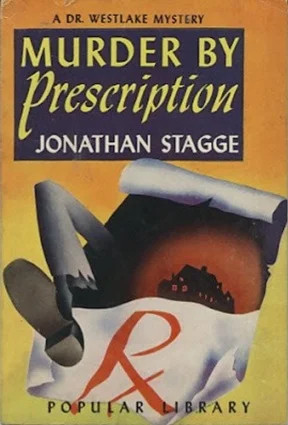
*Murder Or Mercy?*, also known as *Murder By Prescription*, is part of the Dr Westlake series written by Webb and Wheeler under the name Jonathan Stagge. The novel has proved difficult to find in the UK; its reader borrowed a copy from the Bodleian after spending years collecting the series. The image accompanying this review is a US paperback cover, as a UK dust jacket proved elusive.
That scarcity makes the book a worthwhile find for readers following Westlake’s cases, though its appeal isn’t limited to the collection-minded. The mystery keeps moving as Westlake’s work and personal life come under pressure, and Dawn’s presence gives the stakes warmth. The ethical dilemma, the stolen morphine and the missing cats create an unusual mix that won’t suit every reader, but there’s plenty here to hold the attention. For anyone tracking down the Westlake books, this one looks worth the effort—with the caveat that it’s an imperfect, sometimes uncomfortable read.