Irene Solà’s <em>Dams</em> Finds the Limits of Writing About Home
| Shelf | Book Reviews |
|---|---|
| Date in | |
| Readers | 342 |
In <em>Dams</em>, Irene Solà follows a young writer’s return to Catalonia and asks what fiction can preserve—and what it must leave behind.
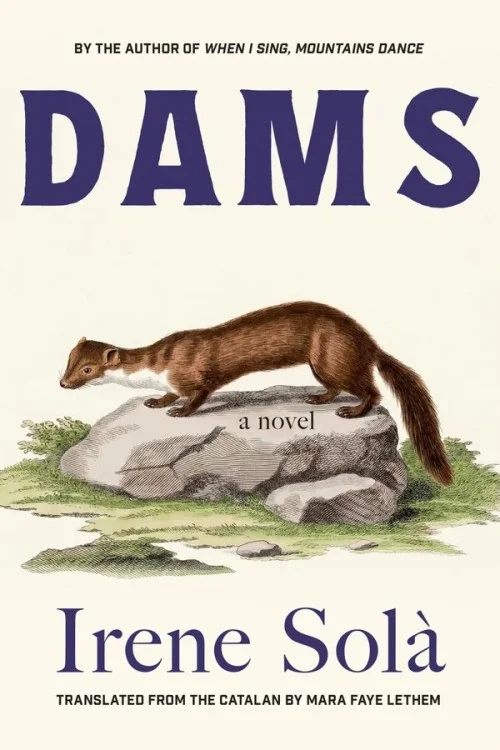
In Irene Solà’s Dams, returning home brings a young writer closer to the very material she hopes to transform. Ada comes from London to Catalonia for the summer, expecting to leave again when the season ends. But family, old friends, a first love and the town’s stories draw her in. Solà makes that pull the novel’s emotional engine and its central artistic question: when a writer uses the lives around her, what can she carry onto the page, and what changes in the telling?
Ada is twenty-seven, old enough to resist her mother’s admonitions and young enough to feel unsure of the person she is becoming. She spends time with her brother Quim and sister Nadià, reconnects with friends and begins sleeping with Vicenç Jr., her first love. The summer brings familiar pleasures and awkward tensions in close quarters. Ada thinks she knows what she wants: to return to London and move on. Yet the place she regards as something to leave behind keeps supplying the people, memories and material that hold her attention.
A writer caught between life and invention
Solà alternates scenes from Ada’s everyday life with stories Ada writes, each set apart by a title in capital letters. The pattern gives the reader two changing perspectives at once: the town as Ada experiences it, and the version she is shaping in fiction. As her summer progresses, Ada’s relationship to home shifts. So does her writing. She is not simply recording events; she is testing a voice, revising people into characters and discovering how little control she has over what those people think of the result.
That tension becomes personal when Ada asks local adults whether she may write about their lives. Nadià is angry to find herself made a subject, and Ada is caught off guard. Her surprise reveals a gap between her idea of writing and the experience of being written about. To Ada, changing names may seem like a way to keep the stories hers while protecting the people involved. To her sister, the act still feels like a claim on her life.
The stories themselves complicate the idea that fiction can be neatly separated from fact. Ada says the names will change in the finished work, but the names remain as we read. Her tales initially feel close to the people and events around her; as they grow stranger and shift into new genres, their increasingly playful invention casts a different light on the earlier stories, too. If the later work makes its artifice visible, it also leaves us wondering how much invention was present from the start.
What the page cannot show
The narration outside Ada’s stories offers another, sharply distinct account. Each part begins with the phrase “This is,” as though the narrator can point to Ada driving, the farm or something happening elsewhere in town and present it as settled fact. The insistence has a quiet irony: a reader encounters all of it through words on a page. The gesture toward direct witness can’t remove the distance between experience and description.
Solà gives that distance a striking image in the novel’s final photographs. Their captions identify one image as blue and another as red, but each appears to the reader as a solid grey block. We have to accept the written description because the color itself is unavailable to us. The device makes the book’s argument tangible without turning it into a simple lesson. Language can tell us what someone saw, or what they believe they saw, while leaving the experience itself beyond our reach.
Ada’s description of her lover’s scent offers a more intimate version of the same problem. She tells him he smells like corn, but the two of them imagine different scents. They share a word without sharing precisely the same perception. Solà uses this small mismatch to suggest how easily an apparently clear description can conceal separate inner worlds. In Ada’s writing, that difficulty expands: she borrows from the lives around her, but every choice of name, tone and genre makes the borrowed material her own in some new way.
Here’s the thing: Solà doesn’t ask fiction to copy life perfectly. Instead, she gives the limits of that effort a place inside the story. Ada’s uncertainty as a writer echoes her uncertainty about returning home; both involve trying to make sense of something that won’t hold still. Her hometown is a source of inspiration, affection and friction, even as she imagines leaving it. The closer she looks, the less tidy the stories become.
That makes Dams both a novel of summer return and a thoughtful exploration of writing from experience. Solà leaves room for nostalgia, romance and the shifting loyalties of family while keeping the act of making stories in view. Readers drawn to fiction about artists at work may find particular pleasure in its questions, while readers who enjoy the texture of a place and its relationships have plenty to follow in Ada’s summer. The book’s lasting invitation is to notice not only what a story shows, but also the gap between the lives we live and the words we use to hold them.
FICTION
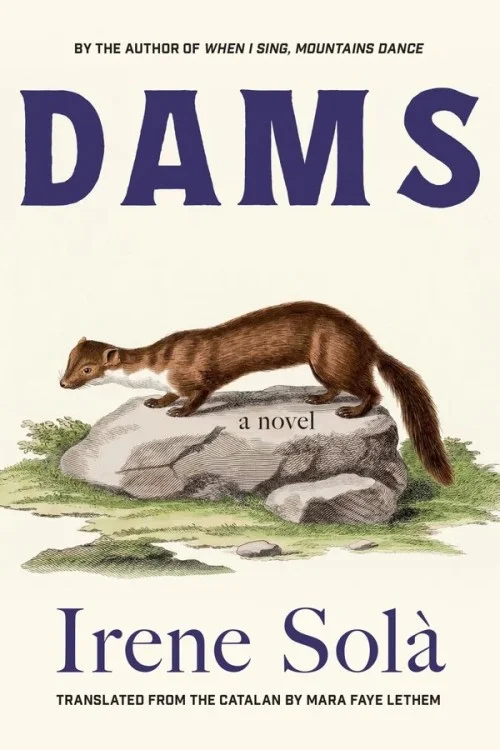
Dams
By Irene Solà, Translated by Mara Faye Lethem
Graywolf Press
Published November 3, 2026