Anne Pauly’s *Before I Forget* Finds Memory and Humor in Grief
| Shelf | Publishing Industry |
|---|---|
| Date in | |
| Readers | 695 |
In Anne Pauly’s 130-page novel, sorting through a father’s belongings becomes a search for memory, family connection and a more complicated kind of love.
Anne Pauly’s Before I Forget begins with the work of taking stock. After her father Jean-Pierre dies, Anne sorts through what remains of his life: belongings from the hospital, practical arrangements, family keepsakes and stories she never knew. The task gives shape to grief, but it also unsettles the picture she has carried of him. In Pauly’s 130-page novel, remembering is less a matter of preserving a fixed portrait than discovering how many versions of a person can coexist.
A father with more than one face
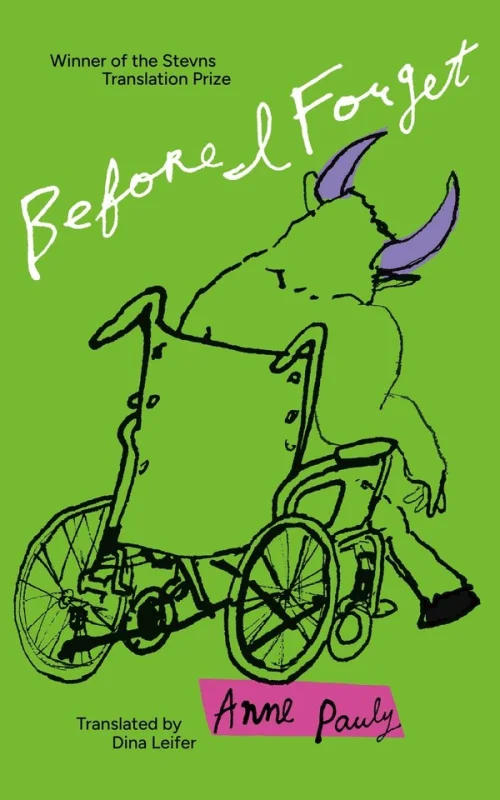
The book’s cover offers a child’s drawing of a horned creature with cloven feet, slumped in a wheelchair. It represents Jean-Pierre as the minotaur of Anne’s childhood, a father whose violence colored her early life. Yet the horns are purple. That detail captures the tenderness and confusion at the heart of Anne’s memories: even within a painful relationship, there were moments when her father comforted her. The image doesn’t erase the harm. It makes room for the parts of him that didn’t fit neatly beside it.
As Jean-Pierre’s illness advances and he becomes more dependent on a wheelchair, Anne watches him struggle with the device and a prosthetic leg. The vulnerability she sees complicates the distance she has built between them. His death then prompts a wider reckoning, one that reaches beyond the facts she knows about his life to the assumptions she has made about her own family history.
That reconsideration depends partly on Juliette, Jean-Pierre’s childhood love. Anne learns more about their connection and begins to see a relationship marked by longing and possible regret. Juliette’s recollections supply evidence of a side of Jean-Pierre that Anne did not experience directly. Their value lies not in settling who he “really” was, but in showing how incomplete any single person’s account must be.
What an inventory can hold
Anne’s lists are both practical and emotional. There are arrangements to make after a death, from booking a church service to clearing the house. There are also the objects and memories that might otherwise disappear. Naming what remains helps Anne stay grounded, and sorting through it gives her a way to add newly discovered stories to old ones. The process becomes a record of what the family shared, as well as what each person remembers differently.
That difference hurts when Anne’s brother Jean-Francois shows little interest in keepsakes or sentiment. To Anne, memories are a catalogue of their shared experience and a means of keeping their father present. She wants to pass along the more generous details she discovers. Her brother’s response leaves her feeling cut off from both her family and the wider world. Pauly makes the disagreement feel larger than a dispute about objects: Anne is asking for a shared account of the past, while Jean-Francois doesn’t appear to need one in the same way.
Juliette offers a distinct kind of remembrance. She and Jean-Pierre had a life together that belonged to neither Anne nor the rest of the family. After Jean-Pierre dies, Anne contacts her. Juliette’s reply gives Anne a witness to the purple-horned version of her father: someone who can confirm that his life held affection and complexity alongside its damage.
Juliette’s letter, written for Jean-Pierre and entrusted to Anne to read and somehow transmit, is one of the novel’s most striking devices. It gathers memories of his goodness, insecurities and worries, turning an account of one relationship into another form of mourning. Juliette never appears in a full scene. Anne knows her through stories, Jean-Pierre’s journal entries, a phone call and the letter, and she attends the funeral without making herself known. That absence is a notable limitation: a conversation among Juliette, Anne and Jean-Francois might have brought the siblings closer to their father’s history. But the distance also gives the letter its force. Juliette’s words arrive as something Anne has long needed and cannot simply claim as her own.
Grief resists a return to normal
For Anne, the letter sharpens the meaning of loss without making it easy to live with. She struggles against the expectation that she should resume her routine as though grief were only an interruption. Rage, panic attacks and visits to mediums become part of her attempt to endure a death she cannot yet accept. The book doesn’t present these responses as a tidy route toward recovery. They show how the ordinary demand to carry on can feel painfully out of step with private sorrow.
A lyric from a pop song, recalled months later, finally helps Anne accept her father’s death and loosen the burden she has been carrying. The moment is small, which suits Pauly’s attention to the everyday objects and fragments that can hold a life. A song doesn’t solve grief. It gives Anne a new way to remember Jean-Pierre, one that allows the relationship to continue changing after his death.
Humor keeps the book from becoming weighed down by its hardest material. Anne’s sharp asides puncture a cruel exchange with her brother and offer wry commentary on people who seem to respond like automatons controlled by tiny puppeteers. The jokes ease tension without dismissing the pain underneath. They also make the narrator’s relationship with the reader part of the storytelling: Anne shapes how we encounter the brutal details, letting comedy offer a brief place to rest.
That balance helps explain the compact 130-page form. Pauly moves through objects, family friction and new knowledge without turning grief into an abstract lesson. Anne may seem to regress as she rummages through her father’s most private belongings, but her humor is also a way to protect herself while she faces them. Before I Forget is most affecting when it lets memory remain imperfect: the past can be painful, loving and unfinished at once. Pauly’s novel is fiction, published by Two Lines Press on October 13, 2026.
FICTION
Before I Forget
By Anne Pauly
Two Lines Press
Published October 13, 2026