Monica Furlong’s Juniper Traces a Princess’s Path to a Different Kind of Power
| Shelf | Genre Fiction |
|---|---|
| Date in | |
| Readers | 819 |
In Monica Furlong’s 1990 prequel to Wise Child, Juniper finds purpose in healing and the natural world as she questions the future she once expected.

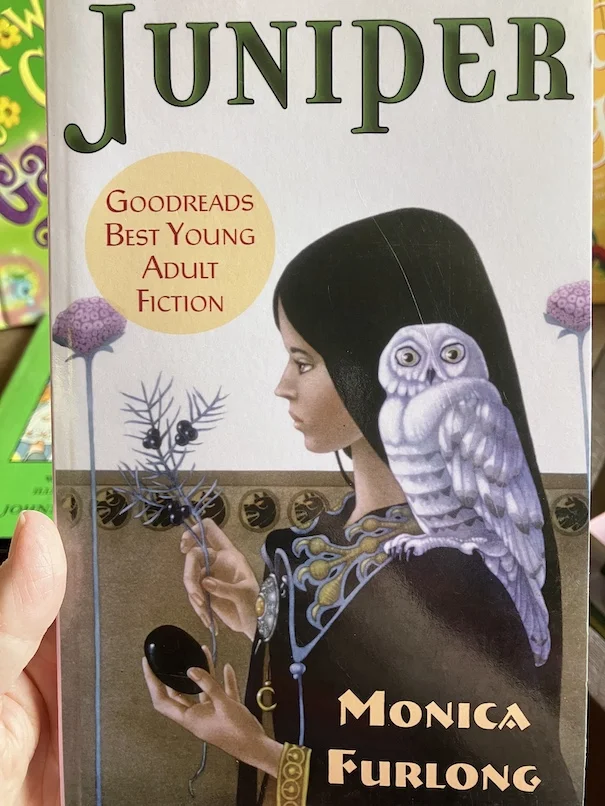
A princess finds another way to live
In Monica Furlong’s Juniper (1990), the central question isn’t simply what powers a young princess might possess. It’s what she’ll do when the future she has imagined begins to close around her. Ninnoc grows up at her father’s castle in Cornwall, surrounded by care and privilege, with every reason to expect that she’ll eventually rule beside a husband. But her talents point toward a different kind of authority: one rooted in healing, close attention to nature and the rhythms of life.
Furlong first introduces Ninnoc’s gifts through small discoveries. As a child, she joins men searching for water and finds it herself. Later, she tends wounds her cousin suffers during his forced warrior training. When she takes in an orphaned owl, she discovers she can hear it speak. The signs suggest that Ninnoc has a gift for magic, though the story’s more consequential question is how she’ll learn to use it.
The owl is one of the few sources of comfort for Ninnoc’s cousin, the son of her aunt Meroot. Meroot expects her boy to become a great fighter and tries to harden him by keeping him hungry and uncomfortable. He would rather make music. Ninnoc and her nurse secretly give him food and kindness, even as Ninnoc begins to understand that her aunt’s cruelty reaches beyond her own child.
Meroot’s hostility toward Ninnoc is difficult to explain when the girl is young. Ninnoc’s father trusts his older sister more than he should, and he has even made her one of Ninnoc’s godmothers, despite Ninnoc’s mother’s misgivings. Ninnoc senses that Meroot resents her family, while her cousin adds an unnerving detail: his mother appears to have some magical ability of her own.
The name Euny gives her
Ninnoc’s other godmother is Euny, a solitary wise woman who lives beyond the protection of her father’s household. Ninnoc dislikes her at first. Euny is ragged and brusque, and insists on calling the princess “Juniper.” Ninnoc’s mother says Euny believes that name is her goddaughter’s true one. She also explains that power takes more than one form. Her father commands knights and holds authority over his people; Euny’s influence comes from another source.
That distinction catches Ninnoc’s attention. She has grown up close to status and power, and expects to inherit her father’s position. Yet she isn’t a warrior, and the abilities emerging in her don’t resemble his. Euny may be able to teach her what she needs. When Ninnoc is told she must spend a year and a day studying with her godmother, she resists the separation from her parents, friends and cousin. She also doesn’t much like Euny. Still, growing awareness of her own gifts—and her worry about Meroot—eventually makes the journey seem necessary.
Euny calls Ninnoc a Doran: someone attuned to the natural world and its cycles. The label offers little explanation. Euny is reluctant to teach in any direct or reassuring way, and her chilly welcome leaves Ninnoc feeling that she has come to the wrong place. At the cottage, she gets little food and an uncomfortable bed. Euny takes her out to gather plants without explaining their uses, then quizzes her on what she sees. Ninnoc pays closer attention over time, but can’t tell what would count as progress.
There’s a purpose to learning to live with less, since Ninnoc has been raised in comfort and needs to understand lives beyond the castle. But the book also makes clear that Euny’s way of teaching goes too far. Ninnoc is often treated more like a servant than a student, and her lack of guidance leaves her unsure what she’s meant to learn. The distinction matters: hardship alone doesn’t amount to instruction.
A winter with Angharad
Their arrangement shifts when Euny brings Ninnoc to visit another Doran, Angharad, and her apprentice, a girl about Ninnoc’s age. Angharad’s household is simple, but it provides warmth, proper beds and adequate food. Ninnoc quickly feels more at ease there. Euny appears uncomfortable with the comparison, and Angharad decides Ninnoc should stay with her through the winter.
Before the girls part, Euny awkwardly admits that she cares about Ninnoc. It’s a brief moment, but it changes how Ninnoc understands the relationship. Euny has little practice expressing affection, and her upbringing was marked by homelessness and deprivation. Angharad doesn’t excuse her treatment of Ninnoc; instead, she asks the apprentice to watch and listen more carefully. Euny, she says, is powerful in her knowledge of nature and healing, even if she’s poor at explaining herself.
With Angharad and her apprentice, Ninnoc learns more about what a Doran’s life can involve. She also starts to see that learning might require observation and patience, even when a teacher doesn’t lay out every lesson. Angharad encourages her to keep attending to Euny, while recognizing that Euny still has important knowledge to share. By the end of the winter, Ninnoc better understands both her chosen path and the difficult woman guiding her.
Euny, too, begins to reconsider. She recognizes that making Ninnoc endure discomfort without helping her understand its purpose isn’t working. When Ninnoc returns, Euny gives her more direction in the healing arts, which she believes will matter to the young woman’s future. Ninnoc grows more willing to claim the name Euny gave her: Juniper the Doran.
Meroot’s grievance and Juniper’s choice
After the year and a day, Juniper returns to her parents’ home with new abilities and a sharper sense of how power can shape people. The harvest has failed, and Meroot is preparing for a large wedding feast after deciding to marry again. Juniper suspects that her aunt has used a harmful curse to ruin the crops. Her training gives her a way to respond, but it also helps her see the wound behind Meroot’s actions.
Meroot was once a princess, but her younger brother’s birth pushed her aside as the likely heir. She hoped he might never have children; when he married and had Ninnoc, her own prospects of taking his place narrowed further. Juniper can understand why that history feels unjust. In her family’s world, fighting and rule are prized, while wisdom and healing carry less status. She, too, has wondered whether a daughter should lose her expected place simply because a younger brother may arrive.
Understanding Meroot doesn’t mean accepting the harm she causes. Juniper uses her healing gifts to undo the curse, and the land becomes fruitful again. The conflict gives her a chance to choose what kind of power she wants. Meroot clings to the authority she believes was taken from her and uses her abilities to hurt people. Juniper wants to protect and heal, though she hasn’t yet resolved what giving up her expected position might cost.
That question becomes personal when Juniper learns that her mother is expecting another child and believes it will be a boy. She feels the jealousy Meroot has carried: the pain of being displaced by a younger brother, and the loss of a future tied to her father’s status. Euny helps Juniper consider that she may have a destiny beyond becoming her father’s heir. Finding it means acknowledging her hurt without letting it turn her into someone who harms others.
The novel is a prequel to Wise Child, published after that book and centered on the coming-of-age story of Juniper, Wise Child’s mentor. Furlong’s Dorans are a fantasy creation, not a historically accurate name for witches or wise women. The story draws on familiar images of people attuned to plants and healing, but its magic belongs to the world of this series.
A rereading of Euny and Juniper
I first read Juniper as a teenager, after Wise Child, and liked it. Returning to it, I’m more uneasy about how Euny treats her pupil. Juniper starts out accustomed to a princess’s comforts, and learning to manage without them could help her understand other people’s lives. But Euny keeps her cold and underfed, gives little instruction and leaves her to work out what she is supposed to learn. Angharad’s household shows that a Doran can live simply without denying an apprentice warmth and adequate care.
Euny also seems, at first, to resent Juniper’s privileged childhood. She mocks the girl’s status and appears to take satisfaction in turning the princess into a servant. Juniper knows that her father has offered Euny a comfortable home on his grounds and other gifts, which Euny has refused. Her difficult living conditions are, at least in part, a choice. I read some of Euny’s harshness as the residue of her own deprivation: she has made a life out of getting by and may struggle to see how much her apprentice needs something different.
Angharad’s intervention gives both characters room to change. Juniper starts to understand Euny’s history and the kind of knowledge she holds. Euny, meanwhile, has to face the gap between her intentions and the effect of her teaching. Their relationship improves as Juniper becomes clearer about her own path, but also because Euny begins to reconcile her feelings toward the girl. That development helps prepare Juniper for the later struggle with jealousy and belonging.
Furlong’s story is especially attentive to the way status can make one kind of strength seem more valuable than another. Juniper is hurt when her younger brother’s expected arrival threatens her place in the succession. The story doesn’t brush aside that hurt; it allows her to recognize her loss before she decides what to do with it. She can see how Meroot’s grievance became destructive, and she has to choose not to follow the same path. Her healing gifts offer another way to matter, even if her society grants them less prestige than rule or fighting.
One scene remains hard for me: Euny makes Juniper kill a pig for food. I understand the practical point—the animal has been raised as food—but Juniper has bonded with it, one of the few animals in Euny’s household. The killing is distressing, and Euny’s insistence that Juniper do it feels like a harsh test. That discomfort sits alongside the book’s larger question about what hardship teaches, and whether a lesson can justify the pain used to deliver it.
Juniper’s coming-of-age doesn’t ask her to stop wanting influence or to pretend that losing the expected inheritance doesn’t matter. It asks her to distinguish the authority she once assumed she would hold from the abilities she can use to make a life of her own. Readers who enjoy character-led fantasy, mentorship tested by difficult personalities, and stories about choosing a purpose may find plenty to discuss here. Juniper is available to borrow and read online through the Internet Archive.