Rudy Mondragón on Boxing’s Hidden Costs and the People Behind the Sport
| Shelf | Publishing Industry |
|---|---|
| Date in | |
| Readers | 578 |
At a faculty pub night, Rudy Mondragón examined boxing’s uneven pay, lasting injuries and the ways fighters assert their identities.
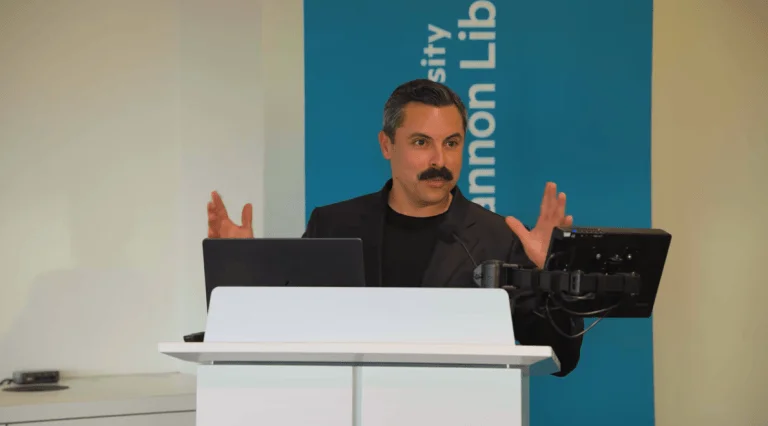
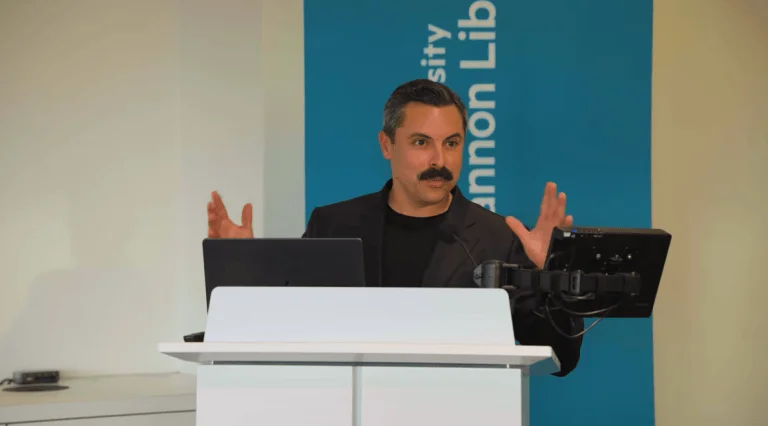
Today’s post was written by library student assistant Mikaela Oliva.
Boxing’s familiar stars occupy only a narrow peak in a much larger industry. At a faculty pub night, Professor Rudy Mondragón asked the audience to look below that peak, where fighters can face uncertain pay, limited support and physical risks that last beyond their careers. His presentation, “Dignity & Dissent: Life in the Brutal Economy of Boxing,” centered the people whose work sustains the sport, including those whose names rarely become familiar to fans.
Mondragón’s interest in boxing grew from family connections and watching fighters such as Héctor “Macho” Camacho and Julio César Chávez. That early interest eventually informed his graduate research and work on “Rings of Dissent.” At the event, he drew on that perspective to consider how the business around a fight shapes the lives and choices of the people in the ring.
A sport with an uneven pay structure
The term “brutal economy” captured more than boxing’s physical demands. Mondragón described fighters as often working as independent contractors, without guaranteed health care, pensions or a federal minimum purse. A chart showing fighter compensation in California made the divide between lower-level competitors and those at the top especially visible.
That gap complicates the assumption, raised during the audience discussion, that boxers simply “make millions.” The highly paid names most visible to the public represent a small share of the profession. For many others, a career in the ring does not promise steady income or lasting financial security. The spectacle can make success look more common than it is, while leaving the working conditions of less prominent fighters out of view.
Mondragón used a pyramid to map the industry’s hierarchy. Opponents sit at its base, followed by prospects, contenders and gatekeepers, then world champions and, at the top, “cash cows.” The diagram gives shape to a system in which fighters can occupy very different positions, even though each contributes to the sport’s activity and appeal.
A stark description from one opponent made the lower end of that hierarchy harder to overlook: “they just bring you to the slaughterhouse. You’re in there to get a beating.” The remark points to the distance between treating a fighter as a person building a career and treating that fighter as a role in someone else’s plan. One audience member said they had known boxing mainly through the “cash cows” at the top and had little sense of the many fighters beneath them. The pyramid brought that contrast into the room.
What shapes a fighter’s path
A faculty member’s question about how an opponent becomes a prospect opened up a discussion of decisions made outside the ring. Talent matters, but it isn’t the only factor. Promoters, managers and matchmaking can influence which opportunities a fighter receives; so can judgments about whether a fighter will draw an audience or generate revenue.
That account complicates the idea that a career advances through ability alone. As Mondragón presented it, boxing operates as a “capitalist industry,” where financial gain and marketability help shape the opportunities available to fighters. The people making those decisions can affect who gets a chance to move up and who remains in a less visible position.
For an audience member, this also changes how a fight can be read. What happens in the ring is only the visible part of a process involving careers, business interests and uneven access to opportunity. The pyramid offered a useful framework for understanding why two fighters in the same sport may have sharply different prospects.
The costs that continue after the fight
The discussion grew more reflective as Mondragón turned to injuries, medical suspensions, CTE and what can follow when a fighter’s career ends. The blows that create excitement for viewers can leave consequences that remain with a boxer long after a match. Yet, as the presentation emphasized, fighters may have little financial or medical support afterward.
A faculty member described this part of the talk as bringing attention to the “vulnerability of fighters that audiences rarely think about” while watching. That vulnerability is easy to miss when a contest is framed around spectacle and performance. Thinking about what happens after a bout, and after a career, widens the frame: the fighter’s story doesn’t end when the audience leaves or the next match begins.
Students and faculty connected the presentation to their own experiences with the sport. One student said a family member had taught her to box and that she already enjoyed watching fights, but she hadn’t understood the extent of the hardship behind the scenes. Others focused on the transition after a career and the role that financial survival can play in shaping a fighter’s life. Even people with some familiarity with boxing came away with a fuller view of the profession.
Identity beyond performance
Mondragón also described ways fighters can resist being defined solely by the industry. A ring entrance offers a boxer a chance to choose clothing, music and an entourage, turning a short, highly visible moment into a statement of identity and dignity.
He cited José Ramírez, who wore a “PRO IMMIGRANT AND PROUD” shirt and appeared with his entourage. In Mondragón’s account, the entrance carried personal meaning beyond its promotional function. An audience member put the broader point simply: “that every fighter enters boxing with a history of their own.” Those histories travel with fighters into the ring, even when the industry reduces them to their performance.
By the end of the event, boxing had come into focus as more than two people fighting. It was an industry built around workers taking real risks, with rewards and support distributed unevenly. Mondragón’s presentation invited the audience to look past the best-known names and consider the people who make the sport possible, their circumstances during their careers and the consequences they may carry afterward. That human perspective is a useful one to take into the next bout.
The post Faculty Pub Night with Rudy Mondragón: What You Missed appeared first on LMU Library News.