Doogie Horner’s Monster Mash Brings Invisible-Boy Mischief to Young Readers
| Shelf | Publishing Industry |
|---|---|
| Date in | |
| Readers | 792 |
Stan and Gene wager on a haunted-house contest to help Stan’s sister. Doogie Horner’s bright, brisk graphic novel is aimed at elementary readers.

Doogie Horner’s The Adventures of Invisible Boy: Monster Mash puts a familiar childhood measure of courage—building the scariest haunted house—at the center of an unlikely rescue mission. The third book in The Adventures of Invisible Boy follows Stan and Gene, boys between 8 and 10 who can turn invisible with the help of Gene’s stain remover. When Stan’s sister gets involved with a group of teens he finds frightening, the boys challenge them to a haunted-house competition. They can’t afford to lose the bet.
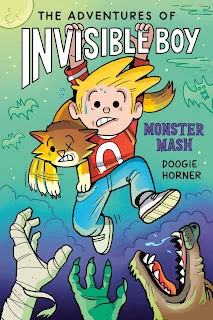
That setup gives young readers a clear goal and an easy way into the story: the boys need to make something scary enough to win, while Stan hopes the contest will help him get his sister away from the teens. The premise is deliberately outlandish. In reviewer Michelle’s view, that implausibility is part of its appeal for elementary-age children, who may enjoy the freedom of a story where stain remover can make someone invisible and a haunted-house wager can become a serious mission.
A simple contest with personal stakes
The competition supplies the plot with a straightforward engine. Stan and Gene have a challenge to meet, and the result matters to Stan because his sister is involved. The story’s focus, as described, stays on the boys’ effort to win and on Stan’s determination to help his sibling. That gives the supernatural hook a recognizable emotional anchor: a child sees someone he cares about in a situation that worries him and decides to act.
The book’s stakes are presented in language young readers can readily follow. The teens seem scary to Stan, and the boys’ proposed solution is a contest rather than a confrontation. Readers who like stories built around a plan, a deadline, or a test of ingenuity may find that structure inviting. It also offers a natural point for discussion about what the boys think they can control, how they define bravery, and whether their contest can solve the problem they have identified.
The available description doesn’t detail how the haunted house is built or how the competition ends, so the central pleasure appears to lie in watching Stan and Gene take on the challenge. That leaves room for the book’s visual storytelling and comic premise to carry the adventure without requiring a complicated setup.
Bright art and a brisk read
Michelle describes the artwork as bright and colorful, and calls Stan and Gene likable. Those qualities suit a graphic novel aimed at younger readers: expressive pictures can make the action easy to follow, while an appealing pair of leads gives readers someone to root for as the contest unfolds. The 188-page length offers more room than a very short comic while still supporting the reviewer’s assessment that this is a fast read.
The plot is straightforward, which may be a plus for children who want a lively story they can move through quickly. Readers looking for layered plotting or a highly plausible explanation for the boys’ powers may be less persuaded. The stain-remover premise is intentionally far-fetched, and the book’s charm, in Michelle’s reading, depends in part on accepting that silliness rather than asking it to behave like realistic fiction.
The review also identifies the main protagonists as white. That detail gives families and educators a useful point of reference when considering representation in a book collection, alongside the story’s age range, tone, and format.
Who may enjoy it
Published by Putnam (Penguin) in 2026, The Adventures of Invisible Boy: Monster Mash is a 188-page graphic novel. The buying advisory lists it for elementary readers in grades K–3, with optional interest beyond that group, and rates its appeal as broad. The content notes list language, mature content, and violence as G; the language notation specifies one swear and no f-word.
That profile points toward children who enjoy colorful comics, implausible powers, and adventures organized around a clear challenge. The story’s sibling concern may also give it a little more emotional weight than the haunted-house contest alone suggests, while keeping the action within a kid-centered frame. For a young reader seeking a quick, playful book, the combination of invisible-boy fantasy and a spooky building competition has an easy-to-grasp hook.
Michelle’s assessment is measured: the leads are likable, the art is bright, and the plot moves quickly, while the premise asks readers to embrace the absurd. That’s a useful guide to the book’s appeal. It looks best suited to children ready to enjoy the rules of its fantasy on their own terms—and to follow two boys who turn an outlandish power into a plan to help someone close to them.