House of Horrors Brings Giant, Menacing Plants to an Early Reader
| Shelf | Genre Fiction |
|---|---|
| Date in | |
| Readers | 359 |
Joe McGee and Teo Skaffa’s early reader pairs a greenhouse mystery with spooky plant illustrations, though reviewer Cindy finds the story hard to follow.

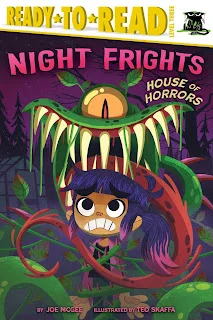
Joe McGee and Teo Skaffa’s House of Horrors (Night Frights) gives young readers a compact spooky premise: Jessica’s greenhouse plants grow gigantic and menacing, then steer the story toward a mysterious patch of ground and a tree on a nearby hill. The setup has the ingredients for an inviting early reader—an eager gardener, an unsettling change at home, and a question that encourages readers to look closely at the pictures. Reviewer Cindy, a middle school librarian with an MLS, finds the story itself difficult to make sense of, while praising Teo Skaffa’s illustrations when the plants turn frightening.
A greenhouse turns eerie
Jessica loves plants, and her father builds her a greenhouse to hold her collection. The plants then grow to enormous size in what the review describes as almost an overnight change. Their new scale comes with a threatening manner, shifting the greenhouse from a place of care and growth into a source of unease.
One spot, however, is left alone. That detail gives the story a small mystery to follow: what makes this patch different, and could it be connected to the spooky tree on a nearby hilltop? The review raises those questions without revealing what lies behind them. For a young reader, the contrast between plants that crowd and menace and a place they avoid offers a clear visual puzzle, even if the larger story did not come together for Cindy.
That distinction matters for a horror story aimed at children. A strange premise can be fun on its own, but readers also need enough clarity to understand how one eerie event leads to the next. Cindy’s assessment is candid: she knows the book is meant to be scary, but still expects the story to make sense. Her reservation gives families and educators a useful point to consider alongside the book’s playful monster-plant imagery.
Skaffa’s plants supply the scare
Cindy singles out Skaffa’s illustrations as a strength, especially once the plants become spooky and dangerous. That visual turn appears central to the book’s appeal. Oversized plants are familiar objects made strange: leaves and stems that might ordinarily suggest comfort or care instead become imposing. For children who enjoy a mild fright, that transformation can give the illustrations plenty to examine and discuss.
Picture-led suspense can also give early readers more than one way into a story. Children can track changes in the plants, search for the patch they avoid, and compare what they see with the questions raised by the text. An adult reading alongside a child might pause to ask what seems unusual in a scene or what the hilltop tree could have to do with the greenhouse. Those are reading prompts, not answers to the book’s mystery, and they leave room for children to make their own observations.
The review’s praise is specific rather than sweeping: the illustrations work particularly well when the plants become menacing. That makes the visual material the clearest recommendation for readers choosing the book. A child drawn to spooky pictures and strange plant shapes may find more to enjoy than a reader who wants every story detail explained clearly.
Who may enjoy this early reader
The book is listed as an early reader, Level 3, and the buying advisory marks it optional for EL (K-3). Its stated appeal is “some,” a useful sign that the subject and execution may suit a particular group of young readers rather than every child in that range. The greenhouse setting, sudden plant growth, and eerie tree give it a recognizable spooky-story shape, while the reviewer’s concern about coherence is worth weighing for children who need a straightforward sequence of events.
For families, librarians, and teachers, the strongest fit may be a child who likes gentle horror and enjoys reading illustrations for clues. The plants’ change from ordinary greenery to threatening figures gives the book a memorable visual hook. At the same time, Cindy’s reaction suggests that an adult may want to look through it first if a clear, tightly connected plot is a priority. Her comment that the illustrated main character is white is also part of her review and may be relevant to readers considering representation in their selections.
Publication details
House of Horrors (Night Frights) is by Joe McGee and Teo Skaffa. Simon Spotlight lists the hardcover at $19, with publication information for 2026 and ISBN 9781665984980. The review is by Cindy, Middle School Librarian, MLS.
Its strongest promise is easy to grasp: a child’s carefully tended greenhouse becomes strange, and the pictures give those changes a spooky edge. Whether the story’s mystery holds together will depend on the reader; Cindy found it confusing. For young readers who prize atmosphere and expressive illustrations, Skaffa’s menacing plants may still make this an appealing pick to browse.