Erin Hoover’s Consent Recasts a Survivor’s Story Through Fragmented Poems
| Shelf | Authors & Interviews |
|---|---|
| Date in | |
| Readers | 597 |
Erin Hoover’s third collection, Consent, follows the uneven work of healing through documentary poems and a cover painting by Audrey Ryan.
Erin Hoover’s Consent, forthcoming from Black Lawrence Press on May 11, 2027, takes a fractured form to tell a story shaped by coercive control and recovery. The third poetry collection follows a woman attacked by her former partner on an ordinary morning as she takes her child to school, then moves through the events that lead to the assault and its aftermath. Hoover’s central subject is the uneven work of healing: progress can come in fits and reversals, while memory refuses a neat sequence.
That structure gives the collection room to hold competing records of experience. Hoover brings together language from BDSM protocols, shelter pamphlets, survivor testimonies, notes on her own writing from during the relationship, and interviews recorded in recovery. These documentary materials meet narrative poems in a deliberately non-linear account. The shifting sources reflect how traumatic memory can surface in fragments, and how an individual’s understanding of an experience may change as she revisits it.
Hoover describes Consent as a departure she hadn’t anticipated, one that required her to confront the personal history behind it. She also sees a through line to her earlier books: her poems have long examined agency and control, with particular attention to women. The new collection carries those concerns into a more exposed and personal register while asking how a survivor can locate truth amid conflicting stories and recollections.
A continuing interest in power and womanhood
Hoover’s first collection, Barnburner, draws on the rural Pennsylvania setting where she grew up. It has been described as a contemporary coming-of-age story about womanhood in America, including the violence that can shape some women’s lives. Her second collection, No Spare People, considers gendered power in the American South and challenges incompatible expectations around motherhood. It also celebrates the small family Hoover shares with her daughter.
In Hoover’s account, Consent broadens the frame around an abusive relationship. The harm doesn’t stay within the home: it extends to the apartment parking lot and later into the courts. That movement is part of the book’s interest in how social narratives, including those about class and motherhood, can distort the understanding of individual lives. Rather than arrange the story as a steady progression, Hoover uses fragmentation and recurrence to approach experience from multiple angles—and to affirm the truth those forms can reveal.
The collection’s form also speaks to the distance between a controlling account of events and a survivor’s own knowledge. By setting personal writing alongside interviews and public facing materials, Hoover places intimate recollection in conversation with language created to describe abuse and its effects. The result, as the book’s description presents it, is an account attentive to the expectations placed on partners and children living with domestic violence. Its focus stays with the survivor’s perspective and with the difficult return to a sense of self.
The cover’s divided figures
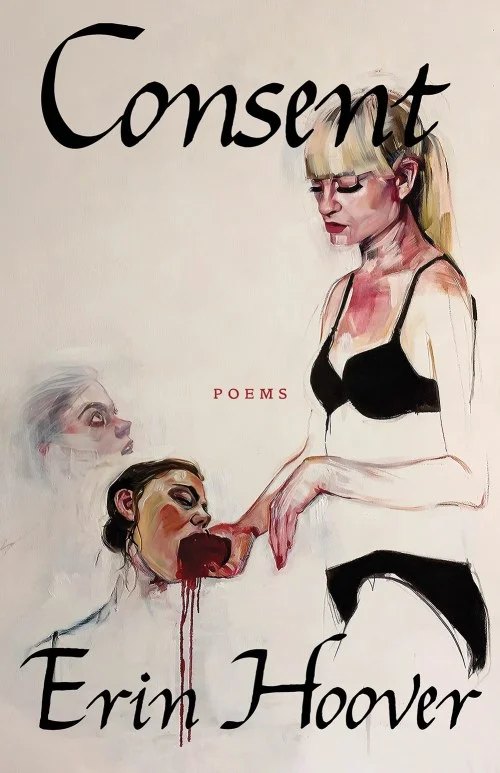
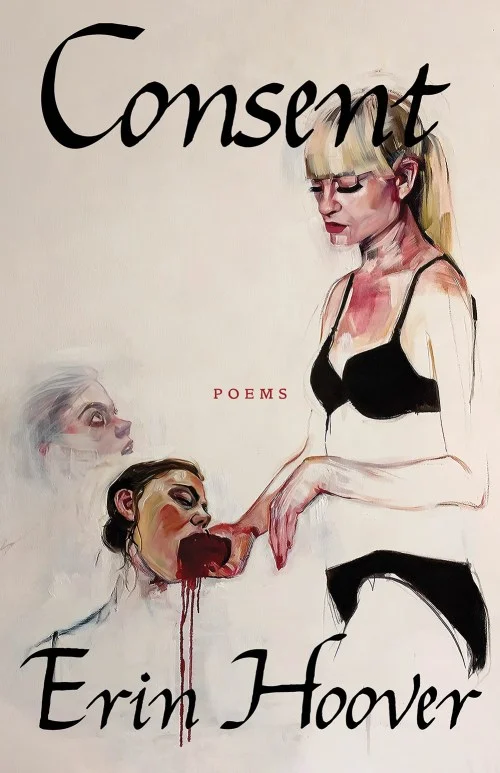
The cover features artwork from “In Dreams,” a painting by Audrey Ryan created around 2014 for a show called Black Hole. Ryan says the work draws on her relationship with girlhood, dysfunction, addiction, disorder, trauma, desire and friendship, while making room for cuteness too. The cover image offers a suggestive visual companion to a collection concerned with the unsettled boundaries between desire, power and consent.
Hoover first encountered Ryan’s work when they were fellows at Vermont Studio Center. She reads “In Dreams” as evoking the careful psychological negotiations behind a BDSM scene. Its two female figures, including one whose form appears divided to contain the standing figure’s eye, suggest to Hoover a fractured sense of self. That image connects with poems about consent being withdrawn within an abusive relationship.
Designer Zoe Norvell worked with Hoover to shape the cover. Hoover says Norvell’s design keeps Ryan’s painting prominent, letting its imagery carry the cover’s symbolic weight. The lettering for the title and author name has a simple brush-stroke quality that, in Hoover’s reading, hints at the contractual terms embedded in power dynamics. Together, image and typography frame the book’s inquiry without reducing it to a single explanation.
Publication details
Hoover is the author of Barnburner and No Spare People. Originally from Pennsylvania, she lives in Cookeville, Tennessee, where she teaches creative writing and literary editing as an associate professor of English at Tennessee Tech University. She curates and hosts the in-person poetry series Sawmill Poetry, produces the “Not Abandon, But Abide” interview series for Southern Review of Books, and is the inaugural Poet Laureate of Cookeville, Tennessee, serving through December 31, 2027.
Consent is poetry by Erin Hoover, published by Black Lawrence Press and scheduled for release May 11, 2027. Preorders are open.
POETRY
Consent
By Erin Hoover
Black Lawrence Press
Forthcoming May 11, 2027

The post Exclusive Cover Reveal: A First Look at Erin Hoover’s “Consent” appeared first on Chicago Review of Books.
===