K-Ming Chang’s Needlemouth Turns Girlhood and Family Memory Into Horror
| Shelf | Book Reviews |
|---|---|
| Date in | |
| Readers | 450 |
K-Ming Chang’s Needlemouth pairs visceral horror with an intimate account of family trauma, though its relentless style can make the story hard to reach.
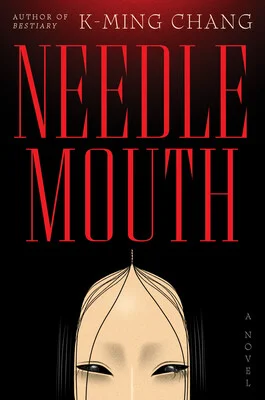
Needlemouth, K-Ming Chang’s latest novel, makes girlhood itself feel haunted. Three cousins spend the summer at their grandmother’s house, where their ordinary world gives way to dead birds, grisly games and a monster hungry for blood. The novel asks what happens when family history becomes part of the threat—and whether the girls can escape the stories they’ve inherited.
Cindy, Mandy and Yangyang move through a dreamlike horror in which the dead monster Needlemouth claims Cindy as an ancestor. The cousins are captured and forced to navigate grotesque visions, gradually confronting the links between the demon’s past and their own. Chang builds the story around pairs that keep slipping into one another: ancestor and descendant, remembering and forgetting, dream and waking life, mother and daughter. The girls’ struggle for freedom is also a struggle with the weight of becoming women.
Family bonds that wound and protect
The cousins’ immediate world is shaped almost entirely by women. Their fathers are absent or described as selfish and draining; their mothers and grandmother are part of a chain of difficult relationships that runs across generations. The reviewer found the novel’s account of inherited family trauma honest and affecting, especially in its portrayal of the ways care can become tangled with pain. At the same time, the reviewer found the broad negative portrayal of men harder to accept.
That tension matters because the cousins’ closeness is neither gentle nor simple. They protect one another, punish one another and carry the habits of the households that raised them. Mandy’s declaration to Cindy, “I’m punishing you because I love you,” captures how affection and harm can coexist in a family’s language. The girls’ bond gives the story emotional force, even as their shared past seems to narrow the lives they can imagine for themselves.
Chang makes that pressure physical. The cousins wade through excrement, swallow needles, experience sexual pleasure, and hurt or kill others. Needlemouth stalks them and demands their blood, while fears that might otherwise remain private take on monstrous form. These scenes make the novel deliberately difficult to inhabit. The body is where fear, desire and family history meet, and the girls’ discoveries come at a cost.
A vivid style at full intensity
The novel’s strongest images come from Chang’s poetic, metaphor-rich prose. In one memory, a mother throws her child out a window and into the water, telling her to become a beluga whale. She urges the child to swim away from her and toward the Pacific. The image gives abandonment a strange, almost beautiful shape, while keeping the loneliness at its center. Elsewhere, the cousins’ exploration of sexual pleasure sits beside their efforts to escape, making desire one part of a wider fight for agency.
But the same intensity that gives individual moments their charge can become tiring over the course of a nearly 300-page horror novel. The reviewer describes reading it as trudging through mud, with the prose pressing heavily enough to demand frequent breaks. Mandy, Cindy and Yangyang each take turns narrating, yet their voices often share the same long, sensory passages. Their different fears and desires don’t always produce clearly distinct ways of seeing the world.
The book’s many metaphors and shifting emotional truths add another layer of difficulty. Mandy can be both drawn to Needlemouth and sorry for her. That contradiction may suit the novel’s interest in relationships that refuse easy categories, but the reviewer sometimes struggled to understand why particular scenes mattered. The style asks readers to stay inside its images; for some, that immersion may deepen the dread, while for others it may obscure the story’s movement.
Specific roots, open questions
The girls’ ages are never given beyond their order—Mandy, Cindy, then Yangyang. They play pretend but also solicit men online, and the uncertain sense of their age leaves readers without a clear measure for judging how much life experience they have or what they should be able to endure. The reviewer found that ambiguity shifted attention toward the events themselves, while also leaving the cousins’ vulnerability open to interpretation.
The novel likewise leaves the girls’ cultural background unnamed, even as details point toward Taiwan. The text uses “Ama” for grandmother, refers to “the island,” and includes Chinese-language proverbs and culturally shaped dialogue. The reviewer read these touches as specific, even while the absence of an explicit label seemed to reach for a broader, more universal frame. For this reader, the cultural details remained visible and meaningful rather than dissolving into generality.
A story within the story, arriving in the third act, offers a striking change in pace. Its more restrained descriptions reserve the sensory intensity for moments that carry particular weight. The relationships between its narrator and two family members also feel clearer and more grounded than the cousins’ often uncertain connection to Needlemouth. The reviewer considers this sequence among the novel’s most fascinating and horrific, and wished that more of the book had made room for the same clarity.
By the end, the haunting reaches all three cousins, not Cindy alone. Their characters remain closely bound to their upbringing and the ordeal they face, giving the novel a contained conclusion. The reviewer sees real promise in Chang’s frank treatment of family dynamics and in the images that ask what makes a person herself, and what freedom from inherited pain might require. Needlemouth offers readers an unsettling, often beautiful vision of girlhood under pressure; its emotional center may take work to reach, but its questions linger.
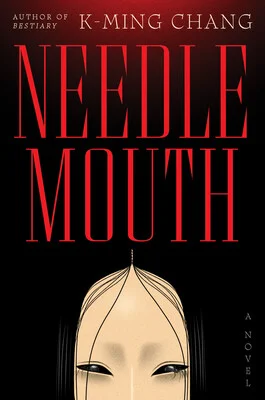
FICTION
by K-Ming Chang
Simon & Schuster
Published October 20, 2026

The post The Horror of Girlhood in “Needlemouth” appeared first on Chicago Review of Books.
===