Jane Schoenbrun’s *Public Access Afterworld* Turns Screen Horror Toward Trans Storytelling
| Shelf | Book Reviews |
|---|---|
| Date in | |
| Readers | 419 |
Jane Schoenbrun’s debut novel completes their screen trilogy with a media-haunted mystery whose deepest questions belong to trans heroine Bethany Peters.
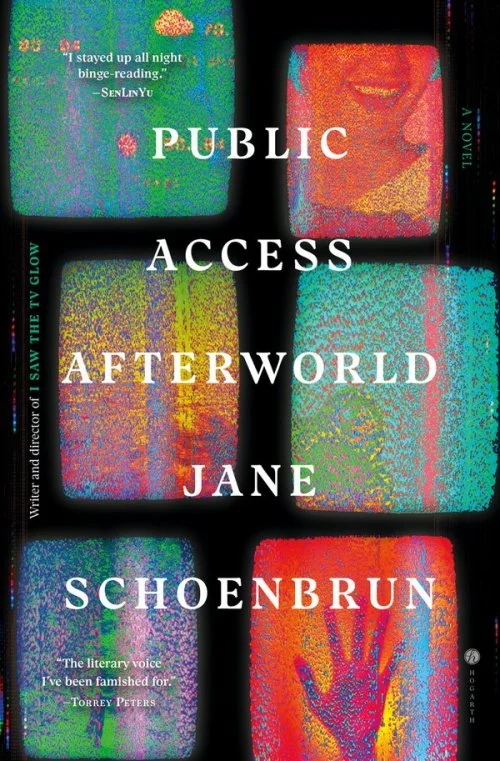
Jane Schoenbrun’s debut novel asks who gets to control the stories that reach us through a screen—and what happens when someone takes that power back. Public Access Afterworld builds a strange, unnerving mythology around television, online video and an alternate dimension, then turns its attention to Bethany Peters, a trans woman whose fight to survive becomes a challenge to the limits placed on trans stories.
Schoenbrun has described the book as the final entry in a “screen trilogy” that began with their films We’re All Going to the World’s Fair (2021) and I Saw the TV Glow (2024). Their latest film, Teenage Sex and Death at Camp Miasma, isn’t part of that trilogy, though the novel and film share an interest in hidden worlds and the origins of moving images. Readers who know Schoenbrun’s earlier work will recognize the recurring questions: What makes an experience real? Who gets to tell a person’s story? And how much control can anyone claim over the images that shape their life?
A story inside a television show
The novel announces its interest in authorship before its central mystery begins. Its unnamed narrator opens by saying, “This book is not my own.” The account, they explain, comes from a friend they met while both were patients in a psychiatric facility. That friend had been consumed by a television show and needed to tell its story; now the narrator is writing it down to clear it from their own mind. The result is a narrative nested several layers deep: a book recounting a show about people who create shows in another dimension.
That invented world is Public Access Afterworld, where patients in a hospital create television programs without actors or production crews. Their imagined characters and settings somehow appear on screens in our world. The novel adds a wider conspiracy to the premise: the dimension has been known about since the Chicago Project, a lesser-known counterpart to the Manhattan Project, and a technology billionaire descended from its lead scientist is helping the other world find new patients. The setup has the uncanny logic of The Twilight Zone, with an echo of the reality-bending eighth episode of Twin Peaks: The Return.
The first episode introduces Erin Morrison and David Sawyer, teenagers spending the night together in Erin’s basement on June 12, 2009, the switch from analog to digital broadcasting. After midnight, drinks and a first kiss give way to awkwardness. Then Erin sees an image beneath the television static: Public Access Afterworld, reaching toward her. She is pulled through the screen and disappears.
The opening carries a deliberate resemblance to I Saw the TV Glow. That film follows Owen and Maddy, teenagers drawn together by a program called The Pink Opaque, until Maddy vanishes. But Erin doesn’t return with revelations. She is presumed dead, and suspicion falls on David. He believes she is still alive inside the static, and his search for her—and for the truth about the dimension—leads him to become a cult leader. That turn gives the novel room to break away from the film’s pattern and reshape its familiar ingredients.
Screen sickness and online performance
In “Episode Two: The Receiver,” the focus shifts to Jules Estrada, a nonbinary mini-golf attendant who posts videos on GlobalVill, the novel’s YouTube analogue. Jules hopes the videos will bring them into David’s cult. Their clips include staged self-harm and pleas for help, recalling Casey’s online challenge videos in We’re All Going to the World’s Fair. In that film, viewers can’t tell whether the changes participants describe are real, performed to sustain a shared fiction, signs of emerging psychosis, or some mix of the three. Schoenbrun makes Jules’s performance more legible: they’re pretending. Yet the symptoms David hopes to provoke in others are real.
The novel gives those symptoms a name: “Screen Sickness.” It can involve anxiety, insomnia and hallucinations of sound or sight. In its most advanced stage, a person sees The Video Store, an interdimensional passage between the everyday world and Public Access Afterworld. Once it appears, abduction may be close. The Static People, figures who emerge in a person’s field of vision, are the escorts to the other side.
That image invites readers to supply their own visual language. I pictured the Static People as tangled marks in the grainy black and white of old television snow; someone else might see them as the monochrome figures in Teenage Sex and Death at Camp Miasma. That film’s hole at the bottom of a lake, where the movies come from, opens onto a pocket dimension that invites comparison with the novel’s source of television. Public Access Afterworld is more crowded and far less freeing. The similarities suggest that the film and book may have informed each other as Schoenbrun explored related ideas through different forms.
References with a purpose
Self-reference can be a thin pleasure: a familiar name or image placed in a new work for fans to spot. Schoenbrun’s echoes carry more weight because they connect separate stories through a shared concern with identity and authorship. The novels’ parallels with the films make the screen trilogy feel less like a set of clues to decode than an evolving conversation about who has the power to shape an image.
For me, a useful comparison is François Ozon’s 8 Women, a farcical French mystery shaped by the films of Douglas Sirk. Its saturated colors and carefully framed images place it in conversation with Sirk’s melodramas. But one brief line adds a more personal resonance: Catherine Deneuve’s character describes remembering her dead lover as “une joie et une souffrance” (“a joy and a source of suffering”), repeating a line from François Truffaut’s The Last Metro, which also starred Deneuve. The camera then turns to Fanny Ardant, Truffaut’s partner at the time of his death and the mother of one of his children. The reference works even if a viewer misses its origin; the moment makes grief part of the film’s emotional texture.
Schoenbrun’s self-references can work in a similar way. Their first two films have been read as stories about the “egg crack,” the moment someone comes out of their shell and acknowledges that they’re trans. Public Access Afterworld shifts the focus to life after that moment. Its emotional center isn’t David, Erin or Jules. It’s Bethany Peters, a trans woman in Texas trying to build a life amid strained family ties, precarious work and isolation.
Bethany takes control
When Bethany appears in the second episode, she is estranged from her parents and living with a boyfriend who supports her financially. Her best prospect is an overnight job moderating GlobalVill videos. She has to review a steady stream of disturbing material, including Jules’s clips. That work helps bring on her Screen Sickness, though she assumes her symptoms stem from stress and her history of mental health struggles.
The explanation is more sinister: GlobalVill’s CEO is secretly giving her psychedelics as part of an experiment, while working with Public Access Afterworld to draw in patients. The novel connects the intimate dread of watching upsetting videos with a larger system that can manipulate the people responsible for reviewing them. Bethany’s job puts her close to the material, but the people in charge have made her a target.
Making Bethany the central heroine gives the book its clearest argument. Trans women are often confined to stories that cast them as victims, threats or spectacles. Here, Bethany becomes the person who can uncover how Public Access Afterworld works, rescue Erin and the other patients, and alter the rules governing reality. She isn’t a symbol set outside the action; she’s an active force within it.
That choice raises a compelling question: what might television become if a trans person could shape every part of it, even destroy the medium that has carried the story? Schoenbrun leaves that question open. The show nested inside the novel may or may not receive another season, and the book doesn’t offer a tidy answer to what trans storytelling looks like after it breaks through the screen. Its lasting charge comes from handing Bethany the power to ask. Public Access Afterworld was published by Hogarth on October 27, 2026, and Schoenbrun’s next work is now part of the story’s open horizon.
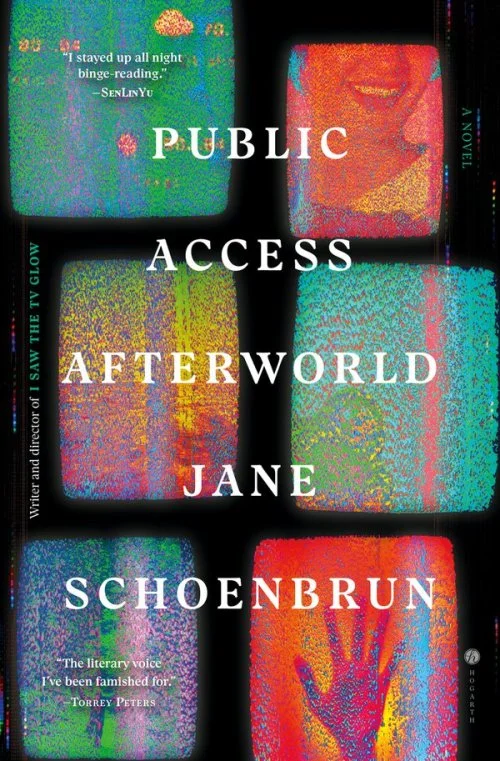
FICTION
Public Access Afterworld
By Jane Schoenbrun
Hogarth
Published October 27, 2026
The post The Screen Is the Egg Is the Crack: Jane Schoenbrun’s Public Access Afterworld appeared first on Chicago Review of Books.