Marlon James on Queer Intimacy, Violence and His Novel The Disappearers
| Shelf | Book Reviews |
|---|---|
| Date in | |
| Readers | 872 |
Marlon James discusses the queer gaze, storytelling and Jamaican masculinity in The Disappearers, a novel shaped by intimacy, violence and humor.

Marlon James didn’t set out to make The Disappearers an easy story to read. The novel follows eight queer men in 1980s Kingston through secrecy, violence and the long work of living afterward. Yet its account of harm is threaded with wit, hope and unexpected humor. That balance—between what the characters endure and the life they keep making—is central to the book’s force.
James describes the novel as written in what he calls “the queer gaze.” He wasn’t interested in shaping gay intimacy for an assumed straight audience, or in smoothing the characters’ experiences into familiar romantic conventions. His aim was to let their stories, desires and contradictions occupy the page on their own terms. The result is a sprawling work that moves across decades and shifts among narrators, asking who gets to tell a story and who gets to hear it.
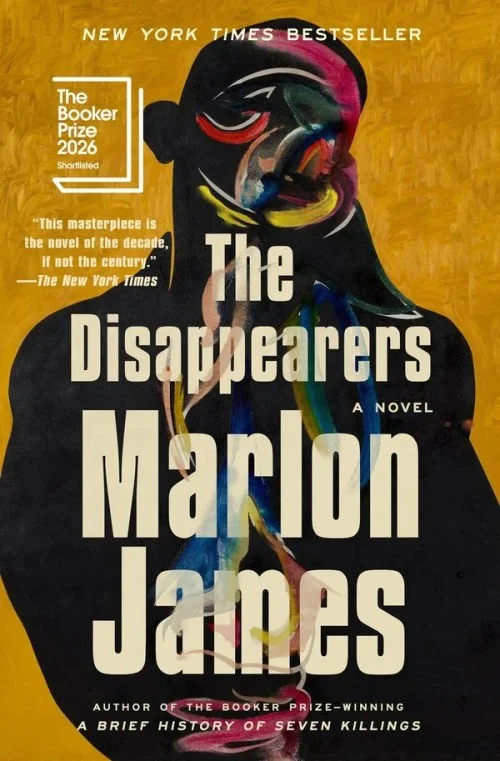
The Disappearers, published by Riverhead Books on September 1, 2026, was longlisted for The Booker Prize before publication. James won that award in 2015 for his third novel, A Brief History of Seven Killings. The new novel became an instant New York Times bestseller and drew him into a busy, multi-city tour. In an interview a week after its United States release, he spoke with Stephen Patrick Bell about the book’s roots, its shifting voices and the subjects that keep pulling him back.
From screenwriting to the novel
James initially resisted linking The Disappearers to his work on Get Millie Black, the television series that includes the character Hibiscus and spends time with Jamaican queer life. Looking back, though, he sees that writing for television gave him a kind of “road test” for related material. Both works include people known as gutter queens, but they place that material differently. On the show, he said, Hibiscus’s story is part of the larger action; in the novel, queer life becomes the action itself.
That shift gives James room to stay with the characters and their world at greater length. The book’s setting is not simply scenery for a plot about violence. It’s a place shaped by memory, social boundaries and the daily choices available to its queer characters. James’s Kingston reaches back to a period he presents as more dangerous than the present, while the novel’s decades-long span lets readers see how its characters change—or fail to.
Bell raised the novel’s dark humor and its interest in revenge, themes that also run through James’s Dark Star Trilogy. James readily acknowledged his attraction to revenge stories, but his characters rarely find satisfaction in them. “That revenge restores nothing,” he said. “It repairs nothing.” The pursuit may feel electrifying, yet the people who pursue it still have to face the emptiness that first made revenge seem necessary. For Jordan, especially, getting even doesn’t settle the deeper damage.
Jordan’s certainty, and what it costs
Jordan is one of the novel’s most forceful personalities: quick to make claims about Jamaican identity and what does or doesn’t belong within it. James sees that confidence as part of the character’s youth. Jordan speaks with conviction before he has lived through the experiences that might complicate his conclusions. He learns some lessons, James said, though he isn’t sure Jordan learns all he needs to. In the end, he may leave the story “a lesser person” than he was at the start.
James also described a change in the social conditions around queer life in Kingston. Before AIDS, from the 1970s into the early 1980s, the city had several gay bars. As he recalled it, a typical response from someone who wasn’t gay was to avoid those places, rather than try to destroy them. His observation gives Jordan’s reflections on Jamaican identity a historical dimension: the boundaries he tries to define don’t hold still, and the world around him changes in ways he can’t simply explain away.
The book’s humor and liveliness matter in that context. James fills his Kingston with well-read, sharp-tongued characters, including Eddy Porteuous and Jordan Brown, whose personalities keep the novel from becoming a single, unbroken register of suffering. Bell described the book’s shifts between pain and levity as part of what stayed with him. James’s characters can be funny, charming or difficult even as they face danger; those qualities don’t cancel out the violence, and the violence doesn’t erase their capacity for pleasure and play.
Characters who take over
Asked how he arranged the novel’s sections—including a sequence of letters from Havelock—James joked that better planning might have produced shorter books. He does write extensive plot outlines before beginning, but once the actual writing starts, he sets them aside. “Characters become people,” he said, and stop accepting directions from him. They surprise him, disappoint him and behave in ways that a neat outline can’t fully predict.
That openness is part of his approach to storytelling. Many of his novels use first-person narrators, and he’s interested in the craft built into that choice: who tells the story, who is listening, and how much confidence a reader should place in any particular account. In The Disappearers, narrators have differing degrees of reliability. Their voices create a picture of events without offering a single, authoritative explanation.
The book also leaves some listeners outside the frame. Bell observed that characters often address a specific, real or imagined audience, while readers never hear a direct reply. For him, that absence sharpened the loneliness of queer people who hide their identities for safety. James said he didn’t want to turn the novel into a chorus of voices, or to repeat the many-narrator structure of A Brief History of Seven Killings. He prefers a story that moves with the unpredictability of life: some events recur, while others arrive without warning and force the characters to respond.
The shifting voices suit a novel in which intimacy is rarely separate from danger. Bell asked whether James had tried to resolve the connection between affection and aggression that runs through the characters’ relationships. James said he wasn’t sure he had reached a resolution or a kind of peace. Instead, he wanted to acknowledge how romantic encounters can contain, or flirt with, violence.
Masculinity beyond the book’s romances
For James, the characters’ sexual lives reflect the constraints around them. Queer men, he said, don’t get to stumble into adulthood or sexual maturity in the same way as straight people. Their development arrives in fits and starts, under rules they didn’t create. Some encounters feel desperate because the characters’ lives leave them scrambling for choices—and at times, with few choices available.
James places that experience within a wider examination of Jamaican masculinity. The novel, in his view, addresses more than the rejection or mistreatment of gay men. It asks how Jamaican men respond when confronted with forms of sexuality that challenge a black-and-white understanding of desire. He described homophobia as bound up with Jamaican mythology, while emphasizing that the subject extends beyond any one group of attackers or victims.
The blackjack section, for instance, includes an attacker who is gay. James pointed to that detail as part of the book’s interest in people who don’t fit tidy moral categories. Some characters have what he called an almost pathological attachment to violence; they might have attacked anyone. He knows he’s working on a large canvas, he said, and the people on it don’t always “add up.” The novel allows that inconsistency to stand.
Writing in the queer gaze
Although the characters read queer literature, the world they inhabit is far from the places where many of those books were written. Asked who might discover The Disappearers, James said he doesn’t spend much time imagining a target reader. He writes primarily for himself, and wanted the novel to remain uncompromising. “I wasn’t interested in writing gay intimacy for straight people,” he said. “It was very much a book in the queer gaze.”
He made the point through a joke about popular depictions of gay romance. James said he had watched Heated Rivalry four times, like many others, but teased the genre’s tendency to present what he called “the pre-lubed and ready gay butt”—characters who seem to move from taking off their clothes to sex without the practical realities in between. His objection wasn’t that such stories shouldn’t exist; he was describing the terms on which he wanted his own book to approach intimacy.
Still, James hopes readers beyond the audience he had in mind will find a way into the novel. Its clarity, he said, should help people recognize that it can be for them. He couldn’t think of anyone who shouldn’t read it. That invitation sits alongside the book’s refusal to make its characters’ lives comfortable or easily explained.
The conversation ended on a lighter question: which character has the best fashion sense? James first considered Jordan, then pointed out that Jordan is often not wearing clothes. His answer was Havelock, who can apparently carry off a green bell or turtleneck in 96-degree weather. Asked whether James might wear green velour on the awards circuit, he replied, “Oh God, I hope not.”
The Disappearers moves between grief, desire, sharp humor and the limits imposed on its characters. James’s account of writing it makes clear why the voices don’t settle into a clean moral pattern: he lets them surprise him, and lets their contradictions remain visible. For readers, that means entering a story whose central questions—about intimacy, masculinity and who gets to tell a life—keep unfolding beyond any one character’s version.

FICTION
The Disappearers
By Marlon James
Riverhead Books
Published September 1, 2026