Joanna Foat Brings Britain’s Forgotten Lumberjills Back to Life
| Shelf | Book Reviews |
|---|---|
| Date in | |
| Readers | 673 |
Joanna Foat traces the Women’s Timber Corps through first-hand memories, revealing hard forestry work, lasting friendships and a fight for recognition.

Britain’s wartime timber shortage brought thousands of women into the forests, where they took on demanding work that many people assumed they couldn’t do. Their contribution was vital, their working lives full of hardship and camaraderie, and their service largely overlooked after the war. Historian and novelist Joanna Foat has spent more than a decade collecting their stories and carrying them to new readers through history and fiction.
Foat first heard about the Women’s Timber Corps while working for the Forestry Commission. The scale of the women’s contribution surprised her: as many as fifteen thousand had worked in Britain’s forests during the Second World War, yet their story was scarcely represented in history books or online. With most of the Corps’ records destroyed, only one sample folder relating to the organisation remained at The National Archives.
Foat set out to fill that gap by interviewing more than sixty former Lumberjills. Their memories brought the work into focus, along with the friendships, laughter, prejudice and physical strain that shaped their lives. A childhood love of chopping wood had already made forestry feel familiar to Foat; she wondered whether, born fifty years earlier, she might have joined them herself.

Lumberjills moving a tree. Photo: Doris Youde (nee Stanyon)
A timber shortage and a new kind of work
Before the war, Britain imported 96 per cent of its timber, with only four per cent grown at home. Forestry employed just 14,000 men. Once many male workers were called up, the timber supply became a pressing concern: millions of tonnes were needed for coal-mine pit props, railway sleepers, telegraph poles, aircraft, ammunition boxes, rifle butts and other military uses.
Officials were initially reluctant to bring women into forestry. They doubted women could manage the physical demands and looked to other groups to fill the labour shortage, including male prisoners, dockyard workers, students and schoolboys. Women, many of whom had worked as domestic servants, shop assistants, secretaries or factory hands, were eager to contribute. Dorothy, a hairdresser from Derbyshire, traded her scissors and comb for an axe and crosscut saw.

Crosscutting with a bushman saw in the woods. Photo: Doris Youde (née Stanyon)
The Women’s Timber Corps was officially established in England in April 1942. The women learned to fell trees, strip branches, run sawmills, measure timber, drive tractors and haul heavy loads. Blistered hands and aching muscles were part of the job. So was public scepticism: some people treated them as decorative additions to forestry rather than skilled workers.
Jessie MacLean recalled being asked by members of military units which regiment she belonged to. Explaining that her work included “felling, snedding, peeling—oh, the pain!—saw bench, stacking, horses and tractors” often failed to convince them. One sailor decided she must work for Bryant and May, making matches. MacLean remembered her anger at the assumption.
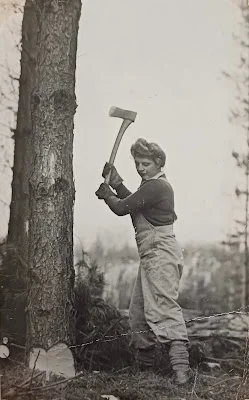
Lumberjill Marion King felling a tree
That disbelief sat uneasily alongside the work itself. The women hauled logs, rode on timber lorries through the forests and handled machinery and equipment that demanded skill and care. Their work made a practical case for their abilities, even when other people were slow to recognise it.

Pulling off the resaw bench. Photo: Doris Youde (née Stanyon)
Training, improvisation and a fifty-five-foot lorry
Training was brief for such varied and hazardous work. Hundreds of recruits went each month to centres including Culford near Bury St Edmunds in Suffolk and the Royal Ordnance Factory hostel near Wetherby in Yorkshire. Courses usually lasted four to six weeks and covered axes, crosscut saws, horses, sawmills and timber haulage.
Heather Rumsby’s first letter home from Wetherby gives a glimpse of the induction. She described waiting in her vest and pants for a medical inspection and having to provide her next of kin, comparing the experience to joining the army. Others received scant instruction and had to learn in the course of doing the job.
Margaret Finch’s story captures the gap between being given responsibility and being prepared for it. At Epping Green in Hertfordshire, her foreman handed her the keys to a fifty-five-foot articulated lorry loaded with trees and told her to deliver it to Welwyn Garden City railway station, seven miles away. Her felling partner, Jean, couldn’t ride a bicycle; Finch could, so the two chose her to drive. Neither knew what the gear stick did.

Tractor driver hauling a tree. Photo: Doris Youde (née Stanyon)
They reached the town, only to find they were going the wrong way down a one-way street. Told to reverse to the turning, Finch and Jean looked at each other and laughed: “We don’t know how to reverse; we only know how to go forward.” The mishap is funny in retrospect, but it also shows how much the recruits were expected to manage with little preparation.
Work without recognition
The Lumberjills’ skills didn’t earn them equal treatment. They faced lower wages, suspicion and prejudice, and the end of the war brought no medals, grants or gratuities. They weren’t permitted to keep their uniforms or take part in Remembrance Day parades.
Audrey Broad told Foat that she only understood years later how little their service had been valued. “We should have got some recognition,” she said. “We didn’t get any money. We weren’t even allowed to keep our uniforms. I thought that was dreadful.” Foat says almost every woman she interviewed spoke about the hurt of being forgotten after doing dangerous and essential work.

From first-hand accounts to fiction
Foat’s first book, the non-fiction history Lumberjills: Britain’s Forgotten Army, draws on the women’s own accounts. She has since carried their experiences into talks, exhibitions, public commemorations and a historical fiction series, The Lumberjills. Fiction lets her build scenes around real experiences while following young women as they discover the limits other people have set for them—and what they can do beyond them.
One of Foat’s first interviewees, Eileen Mark, née Worsell, became the model for Rosie, a seventeen-year-old Cockney character. Mark had grown up in Hackney and worked in a glass factory making baby bottles and poison bottles before joining the Corps. “I was always up for a laugh,” she told Foat, “and if anyone was going to get into trouble, it would be me.” Foat gave Rosie the surname Worsell to acknowledge that the fictional character grew from a real woman’s life.

Lumberjill Eileen Mark (née Worsell)
Mark’s life supplied Foat with stories that hold both hardship and comedy. After pit props she had stacked beside a road disappeared, she went to a nearby anti-aircraft camp to demand an explanation. The soldiers admitted using the wood for a campfire. Their sergeant apologised, offered her tea and cake, and introduced himself as Wally. He later became her husband; they were married for fifty-four years.
Foat’s novels bring together women from markedly different backgrounds. Rosie comes from London; Keeva O’Connor is a country-raised free spirit; Beatrice has a privileged upbringing as a debutante. Their differences give Foat room to explore how women who might not have met in peacetime learn to rely on one another, through disagreements, secrets and loyalties.

Novel: The Lumberjills: Under Suspicion
Suspicion and solidarity
Foat found that mistrust was a recurring part of the women’s experience. Sylvia Evans, whose photograph appears on the cover of Foat’s history, was held overnight after being mistaken for German. Her son told Foat that Evans’s height, blonde hair and jodhpurs had prompted the misidentification. Others found that the communities where they were posted viewed them as “a bit wild and too free”, as Lumberjill Barbara Beddow recalled. Leaving home, travelling independently and earning their own wages challenged expectations of young women’s behaviour.
That strain informs Foat’s novel The Lumberjills: Under Suspicion. Its four women face closed doors, rumours and fragile trust as romance and friendship develop. When the Lumberjills are accused of spying, Keeva tries to uncover the truth before suspicion breaks apart their bonds. The novel is inspired by real events, while its fictional characters let Foat imagine how those pressures felt from the inside.

Novel: The Lumberjills: Stronger Together
The series also follows the friendships that endured beyond wartime. Jessie MacLean said the Corps sparked her love of travel and brought lasting happiness. She remembered friends sharing “joys and sorrows” and helping one another through difficult times; leaving them, she said, was heartbreaking.
For Foat, that solidarity gives the story present-day resonance. Her view is that women’s choices can still be narrowed by bias, family expectations, peer pressure and assumptions at school or work. The Lumberjills’ lives show what opportunity can open up, and how much strength people can find in standing together.
Foat has shared their history through more than 250 public talks, television and radio appearances, exhibitions created with Forestry England and the VE Day 80 celebrations at the Royal Albert Hall. She has also published a Lumberjills photobook. The Lumberjills: Stronger Together and The Lumberjills: Under Suspicion are the first two novels in a planned trilogy.

Author Joanna Foat
Foat is a novelist, historian and expert on the Women’s Timber Corps. Her books and public work preserve memories that might otherwise have remained scattered across private recollections. The Lumberjills’ story reaches beyond the spectacle of women wielding axes: it asks readers to remember the labour they performed, the recognition they were denied and the friendships that helped them through it.
Find out more at www.thelumberjills.uk.