Ernesto Cisneros’s Queso Just in Time Turns Grief into a Time-Travel Story
| Shelf | Publishing Industry |
|---|---|
| Date in | |
| Readers | 848 |
Ernesto Cisneros pairs a boy’s grief for his father with a playful trip into the past in Queso Just in Time, a middle-grade novel.

Time travel gives Queso a chance to know his father as a boy, but the heart of Ernesto Cisneros’s Queso Just in Time is the grief that remains when that journey ends. The middle-grade novel, published by Quill Tree Books in March 2026, puts a child’s longing for more time with a lost parent at the center of a warm, playful story about family, memory and the past’s differences from the present.
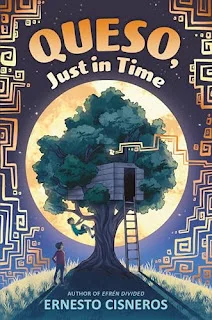
Queso misses his father, Pancho, who died before the story begins, and his grandmother, who has moved back to Mexico. One night, he goes to the treehouse his dad built, holding a remarkably friendly rabbit that has appeared. He wakes up in the past. There, he meets Pancho not as the father he remembers, but as a child himself.
The premise makes a familiar wish concrete: what would it be like to meet your parents when they were young? Cisneros lets Queso experience that strangeness up close. His grandparents take in the boy who has suddenly arrived at their door, and Pancho makes room for him, even sharing his house and his underwear. Those domestic details give the time travel a child’s scale. The past isn’t only a place where history can be altered; it’s also a home where a kid has to figure out school, family and unfamiliar clothes.
A father seen from a new angle
At first, Queso enjoys being with his father again. But the reunion also changes how he understands Pancho. He sees a young person with his own hopes and difficulties, including a dream of succeeding at college and little confidence in his academic abilities. Queso begins to wonder whether he can help Pancho reach that goal. He also makes an unsuccessful attempt to rein in his father’s love of sugar, a small, funny reminder that children don’t always have much sway over adults.
That shift gives the story more to work with than the wish to extend a lost relationship. Queso has to meet Pancho on his own terms, as someone who hasn’t yet become the person Queso knew. The book’s emotional pull comes from that gap between a child’s memories of a parent and the parent’s younger self. Readers may find themselves thinking about their own parents as children, and about the parts of family history they never got to witness.
Queso also encounters a past in which some ideas and forms of support he takes for granted aren’t present. Seeing books about being gay shelved under “Abnormal Psychology” shocks him. The moment brings a change in social attitudes into the story through Queso’s direct experience, without taking attention away from his personal connection to Pancho. For younger readers, that contrast can make the recent past feel unexpectedly distant.
Time travel with consequences
Queso understands that his actions may alter the timeline. When he prevents Pancho from breaking his arm, his grandfather gets hurt in his place, preserving that part of the past in a different way. The mechanics of the time travel aren’t the book’s main concern, but the story does give Queso’s choices consequences. That detail adds tension to a premise built around the temptation to fix what can’t be undone.
The journey doesn’t erase Queso’s loss. When he returns to his own time, Pancho has still died young. What has changed is what Queso carries with him: new memories of his father, made through a relationship he could never have had in the present. That ending, as described by the story, keeps the emotional promise modest and meaningful. The past offers connection, not a permanent escape from grief.
A tender middle-grade read
Queso Just in Time balances sadness with comic touches and everyday observations. School proves overwhelming for Queso, and the differences between his own era and Pancho’s give the book room for both reflection and humor. Retro underwear may get a laugh; a changed understanding of how LGBTQ kids are treated may prompt a longer conversation. The story’s combination of family feeling and accessible time travel should suit middle-grade readers, while its central question has an appeal well beyond that age group.
For book groups and families, Queso’s visit offers a natural starting point: if you could meet one of your parents as a child, what might surprise you? Cisneros’s story follows that question toward something more tender than a second chance. Queso can’t keep his father, but he can return with a fuller sense of who Pancho was—and with memories that make their bond feel newly his own.
===END===