Brenda Iijima’s “Shelter is Necessary for Existence” and the Cost of Looking Away
| Shelf | Publishing Industry |
|---|---|
| Date in | |
| Readers | 874 |
Brenda Iijima’s novel follows a wealthy family whose new home exposes the histories and harms its most incurious member refuses to face.
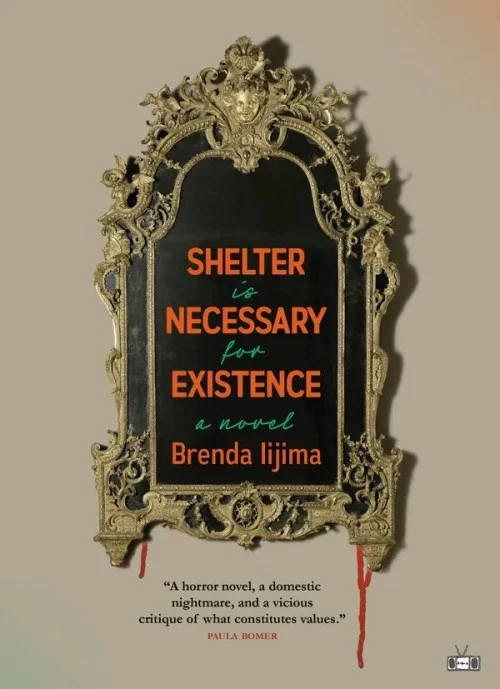
Brenda Iijima’s Shelter is Necessary for Existence asks what privilege makes possible when it keeps a person from examining her life. Its answer is a haunted house and an even more unsettling interior: the mind of Sue, a wealthy New Yorker who meets each disturbing revelation with a fresh opportunity to look away.
Sue is a corporate lawyer, a wife and mother of two, and a recent buyer of a multimillion-dollar brownstone with her husband, Luke. The story begins during the pandemic, when the couple browse listings in other neighborhoods and ultimately buy a house that needs extensive work. The building is rotting, its walls are unstable, strange smells linger, and voices seem to come from somewhere inside. The yard needs attention, too. Sue registers these details, but registration rarely becomes inquiry.
That distinction sets the novel’s rhythm. Sue hears what sounds like two people talking, sometimes in a heated exchange, perhaps on a radio or podcast. She briefly considers the possibilities, then lets the matter drop. The reader, by contrast, has every reason to wonder who is speaking and why. Iijima lets that gap between Sue’s awareness and her curiosity become a source of tension: clues accumulate, while the person best placed to follow them declines to connect them.
Sue’s therapy offers another revealing example. She attends regularly, though the sessions seem to prompt little self-scrutiny. At one point, she takes the therapist’s notebook and sees descriptions of her as “passive with a zombie shadow of self-destructive tendency” and “Vapid, vapid, vapid.” Her therapist retrieves it and tells her, “This can never happen again.” The breach might change the relationship or provoke a reckoning. Instead, it passes, and the sessions continue as before.
A life arranged in episodes
The book’s structure gives form to Sue’s disconnection. Its plot moves forward, but events often feel like separate bursts rather than steps in a developing understanding. Chapters carry simple titles such as “House,” “Therapist,” “Dogwalker,” “Caroline,” and “Wheatley,” the last two named for Sue’s children. These headings recur, returning the reader to the same parts of Sue’s life while showing how little she seems to learn from them.
She performs the role of a mother who knows her children, yet their inner lives remain at a distance. Caroline, her daughter, is deeply distressed by climate change and admires a man who set himself on fire in Central Park as a protest. Sue notices Caroline’s state, but the larger meaning of her daughter’s despair does not seem to take hold. The pattern is less a lack of information than a refusal, or inability, to let information alter her view of herself.
Sue’s work provides the clearest link between her private comfort and the harm beyond it. The novel leaves her job somewhat indistinct, but shows her helping wealthy investors acquire vast parcels of land and resources in other countries, with moral questions pushed aside. Sue remarks that the Ukraine-Russian conflict was “a goldmine for investors.” The line lands because she treats human suffering as a market opportunity, then carries on without apparent reflection.
The violence within the walls
At home, the same evasions take a more intimate shape. Sue and Luke dislike their neighbors, Chantal and Hattori, though Sue cannot give a clear reason for her hostility. Luke’s anger makes the underlying prejudice harder to ignore: in couples therapy, he complains that Chantal “couldn’t find a white man good enough for her.” Sue’s response focuses on how plainly he spoke. That reaction captures her habit of noticing the surface of an ugly moment while avoiding what it says about the people involved.
Luke is portrayed as more openly disturbing than Sue. He dismisses his grandfather’s connection to the Klan, brings guns into the house, and retreats to pornography after inspecting one of them. Later, Sue sees browser tabs showing young children being filmed in sexual situations. She shuts the laptop. The narrative offers no easy emotional label for her response; what matters is how quickly she appears to resume ordinary life, leaving the reader to sit with the enormity of what she has seen.
Nor does Sue treat the house’s physical signs of danger as grounds for sustained attention. She finds blood-caked syringes in her son’s hideout beneath the stairs and assumes they must have been left by a previous resident. When blood seeps from the walls, she paints over it and tries to put the matter out of mind. These episodes are grotesque, but their force comes from their continuity with Sue’s everyday habits: each new warning becomes one more thing she can file away.
The house’s voices offer a counterpoint to that sealed-off perspective. Iijima periodically breaks into Sue’s narration with snippets of the two women speaking. Their exchanges are often good-humored, yet they circle the lives and deaths bound up with the house and the violence beneath the country’s history. Sue frets about hearing them without attending to what they say. The past is audible, even when she refuses to listen.
What a haunted house remembers
The novel’s strongest idea is that forgetting can be a form of shelter, but shelter does not erase consequence. The story suggests that looking back is one way people begin to understand how they came to occupy a place, what shaped their community, and what their own actions leave behind. Sue’s refusal to make those connections protects her from discomfort. It also leaves her unable to grasp the world she has helped shape.
Iijima’s approach is deliberately frustrating. Sue does not turn into a more perceptive narrator as the evidence mounts, and the repeated episodes can make her seem almost sealed inside an endless present. That resistance is also the book’s central design. The reader has to hold together what Sue leaves disconnected: her investments, her family, the voices, the house’s history, and the violence she encounters without confronting.
By the end, the brownstone feels like an extension of Sue’s mind: full of buried histories and signs that refuse to stay buried. The ghosts are fragments of lives that cannot settle into either presence or absence, while Sue’s wealth gives her a dim, insulated vantage point from which to ignore them. Shelter is Necessary for Existence will suit readers drawn to formally episodic fiction and unsettling haunted-house stories, especially those interested in how private comfort can depend on refusing to see. Its lingering question is plain: how long can a person mistake not looking for being untouched?
FICTION
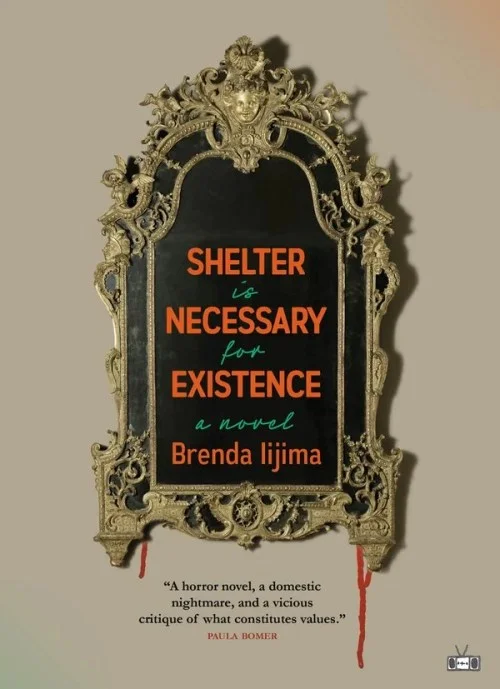
Shelter is Necessary for Existence
By Brenda Iijima
Two Dollar Radio
Published October 13, 2026

The post The Empty Nihilism of Privilege in “Shelter is Necessary for Existence” appeared first on Chicago Review of Books.
===