LMU Faculty Pub Night Examines Counterhegemonic Leadership in Ethnic Studies
| Shelf | Publishing Industry |
|---|---|
| Date in | |
| Readers | 889 |
Seven LMU educators discussed how counterhegemonic leadership can help schools build more inclusive ethnic studies programs.
Today’s post was written by Geneva Longheyer, library student assistant and sophomore political science and journalism major.
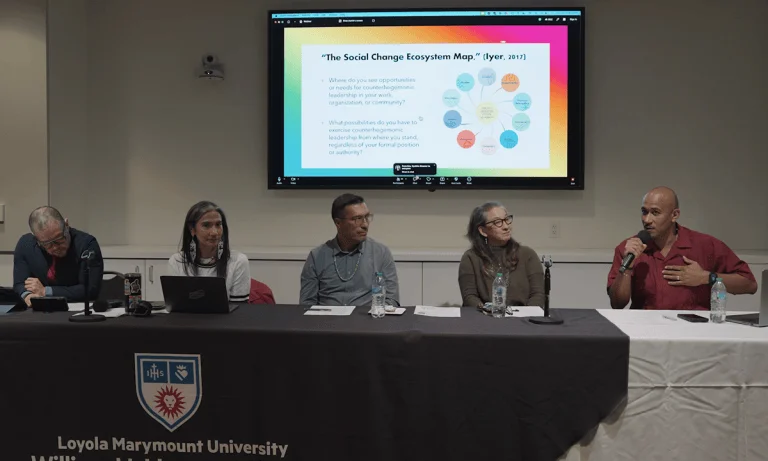
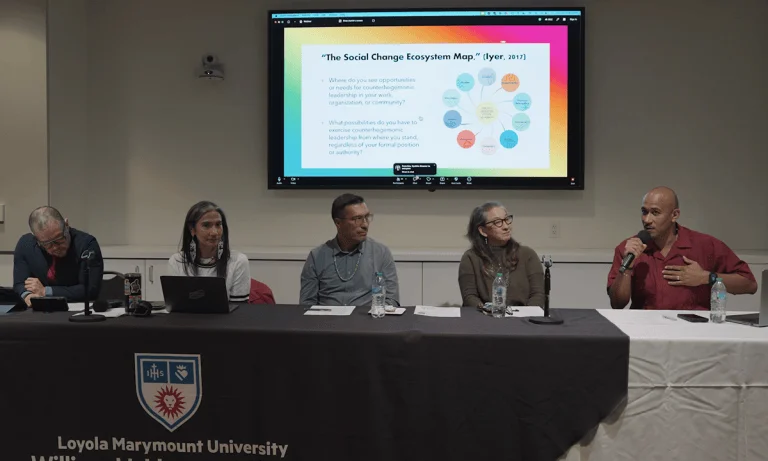
Ethnic studies courses need more than a place on the timetable. At the October 2026 Faculty Pub Night, seven guests from LMU’s School of Education explored the leadership and preparation that help make those courses meaningful. Their discussion drew on the opening chapter they developed for Critical Role of Ethnic Studies in Educational Leadership, with counterhegemonic leadership as its central idea.
The contributors were Joaquín M.S. Noguera, Ernesto Colín, Kenzo K. Sung, Dolores Delgado Bernal, Cynthia M. Alcantar, Kyo Yamashiro, and William Perez. They described leadership as a practice of questioning established ways of working and making room for more inclusive, decolonial change in education and beyond. That frame connects the design of a course to the wider structures that shape who teaches it, whose experience counts, and how schools respond when difficult conversations arise.
Building courses with care
California’s 2021 Assembly Bill 101 requires high school students to complete one semester of ethnic studies to graduate. As districts worked to add courses, the presenters pointed to practical pressures around hiring, staff reassignment, and school administration. When schools move quickly to meet a new curricular need, they may leave too little time for the preparation and support that teaching demanding material calls for.
The concern raised at the event was not simply whether a class appears in the curriculum. Students need educators who are equipped to guide conversations across complex subjects, and school leaders need to be ready to support those educators. If staff background and training receive less attention than speed of hiring, teachers may be asked to handle challenging material without adequate preparation. Administrators, too, may find themselves unready to address family concerns while protecting the quality of classroom learning.
That tension gives the chapter’s leadership argument practical weight. A course requirement can open a door, but the work of making a course thoughtful and well supported falls to the people and systems responsible for delivering it. Preparation, hiring, reassignment, and administrative support are connected parts of that work. The presenters’ account invites educators to ask how each decision affects what students experience in the classroom.
Questioning what seems fixed
Counterhegemonic leadership starts with a challenge to routine: longstanding practices can look neutral simply because they have lasted. The familiar explanation that something is done a certain way because it has always been done can obscure whose needs those procedures serve. Hiring and evaluation offer clear examples. If a process values only a narrow set of credentials or measures, it may overlook relevant experience and create barriers for people from different ethnic groups, communities, and backgrounds.
For the presenters, disruption is intentional: it means examining those assumptions and resisting routines that limit inclusion. That doesn’t make change automatic. It does give educators a way to examine how everyday decisions reinforce existing arrangements, then consider what a more responsive approach could look like. The framework also applies beyond schools, wherever long-running practices shape access and recognition.
The guests linked this work with a “social change ecosystem map” developed by Deepa Lyre, which identifies roles that contribute to social justice. In the discussion, questioning authority and established dynamics emerged as a starting point for engaging with that map. The idea is useful because change doesn’t depend on one person taking every role. A group can begin by asking what needs attention, who is positioned to act, and how different contributions might connect.
A conversation that carried beyond the room
Attendees brought their own experiences to the event, giving the ideas a direct connection to current concerns in schools. One audience member raised the removal of the word “diversity” from schools. Another described ongoing funding difficulties in multilingual education programs, some of which are shifting their focus to English proficiency. These examples showed how the shape of an educational program can change through decisions about language, resources, and what schools choose to name.
The gathering’s sense of care and community helped make space for that exchange. Students and staff from outside institutions were among those attending, and their perspectives widened the conversation beyond the chapter’s authors. The discussion suggested that counterhegemonic leadership can begin in ordinary professional settings: by listening closely, examining how a familiar practice works, and considering whose experience it leaves out.
As the evening ended, the group returned to a concise expression of why history matters to the work: “No history, no self; Know history, know self.” For educators developing ethnic studies courses, the takeaway is concrete: the conditions around teaching matter as much as the course itself. The next test for these ideas will be whether schools pair curriculum changes with the preparation, support, and continued questioning that help students learn from them.
The post Faculty Pub Night with School of Education Faculty: What You Missed appeared first on LMU Library News.