“Heart of Hearts” Exhibition Connects Literature, Art and the Many Meanings of the Heart
| Shelf | Publishing Industry |
|---|---|
| Date in | |
| Readers | 302 |
Curator Ava Lehrman’s “Heart of Hearts” brings literature, art and artifacts together in an exhibition shaped by curiosity and hands-on design.
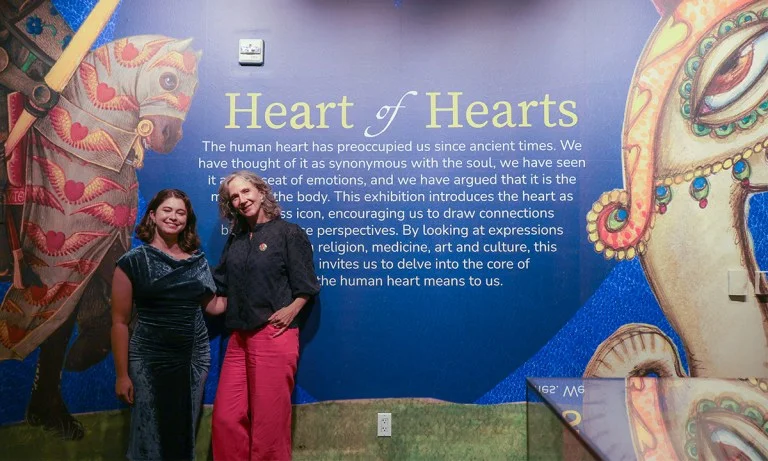
This reflection was written by Cora Chiep, a student library assistant and sophomore double major in English and classics/archeology.
A familiar symbol, many layers
The heart is easy to recognize, but its meanings shift across eras and cultures. That range gives “Heart of Hearts,” the library’s fall 2026 special collections gallery exhibition, its central thread. At the opening reception, curator Ava Lehrman, a graduate student in English, described how she became interested in the symbol and the questions that guided her work. The result, as I experienced it, invites visitors to look beyond the familiar outline and consider how much history and feeling it can hold.
Lehrman’s talk moved between examples with very different origins: the Egyptian legend in which a heart is weighed against a feather in the afterlife, the Christian sacred heart, and the modern heart emoji. Together, those references suggest how a single image can carry spiritual, physical and everyday associations. The heart can stand for a person’s inner life, a religious idea, or a quick expression in a digital conversation. Those meanings are not identical, and the exhibition’s appeal lies in giving visitors room to notice both their differences and their connections.
That breadth also makes the subject inviting to people who arrive with different interests. A visitor drawn to art might start with the visual treatment of the heart; someone interested in literature could attend to how the symbol works in a story or text. Others may come with a personal or cultural association of their own. The show’s subject provides a point of entry, while the range of materials encourages a closer look.
Curating a story within limits
Lehrman spoke about the people around her who inspired the project, as well as the questions that first caught her attention. She also described the uncertainty involved in shaping an exhibition: how to make a narrative from the available material, and how to manage the influence of the choices made along the way. Those concerns became part of a demanding process that she ultimately found fulfilling.
That account offered a glimpse of curation as a series of decisions. An exhibition has limited space and a specific collection of works to draw on, so a curator must decide what belongs together and what story those choices can support. The arrangement needs to offer visitors a path through the subject without reducing every object to a single interpretation. In Lehrman’s description, working within those constraints was difficult, but it also helped give the project a shape.
Her talk made the labor behind the display feel closely tied to its theme. The familiar phrase “labor of love” fits here, not just as a wordplay on the heart, but as a description of the commitment Chiep saw in the project. The exhibition’s considered design reflects that effort, and Lehrman’s enthusiasm was apparent as she spoke about the work. At the reception, the audience appeared absorbed, listening closely as she explained the choices and challenges involved.
Objects in conversation
The exhibition brings literature, art and artifacts together to explore the heart’s significance. Its strength, in Chiep’s view, is that the objects work on two levels: visitors can spend time with each piece on its own, then consider how it contributes to the larger story. That balance matters for a subject with such a wide history. A work can hold its own visual or textual interest while also changing how a visitor reads the pieces around it.
Lehrman extended her role beyond selecting and arranging materials. She personally designed the wall displays in the gallery space, a task Chiep describes as the first time a student curator has taken on that work. That detail makes the exhibition’s physical presentation part of the curatorial project. The walls frame what visitors see, while the display design helps establish how the individual pieces meet one another in the room.
For visitors, that setup offers more than one way to engage. A close reading of a single object can lead into a broader question about the heart’s changing meanings; a walk through the whole gallery can reveal patterns across media and eras. The arrangement supports both approaches, letting people follow their curiosity rather than requiring one fixed route through the material.
A reception shaped by curiosity
Chiep remembers a room full of attentive listeners. People took notes, asked questions and followed Lehrman’s remarks with focused expressions. That response made the reception feel like an extension of the exhibition’s central invitation: to stay curious about a symbol that many people already know, but may not have considered in quite this way.
The opening also made the work’s communal side visible. Lehrman spoke about inspiration from those around her, and the audience brought its own attention and questions to the discussion. A gallery exhibition may be assembled through one curator’s decisions, yet the experience changes as visitors bring their own knowledge and associations to it. Chiep found that shared engagement especially fitting for a project centered on the heart and the meanings people attach to it.
“Heart of Hearts” makes a broad subject feel approachable by pairing distinct forms of material with a clear curatorial thread. Chiep’s reflection leaves the impression of a carefully built exhibition and a reception where the audience was eager to follow its questions. For anyone visiting, the heart offers a starting point; the objects and the connections between them are what invite a longer look.
The original post appeared on LMU Library News, whose site is librarynews.lmu.edu.