Nicola Upson’s The Christmas Clue Brings a Christmas Mystery to Tudor Close
| Shelf | Publishing Industry |
|---|---|
| Date in | |
| Readers | 680 |
Nicola Upson’s Christmas novella pairs the Pratts, creators of a murder mystery game, with a real puzzle at a Tudor Close hotel.
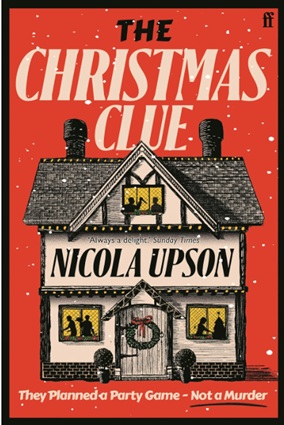
Nicola Upson builds a neat connection between a Christmas mystery and the game at its heart: her sleuths, Anthony and Elva Pratt, are also its designers. In The Christmas Clue, a novella set in 1943, the couple arrive at Tudor Close hotel to host a murder mystery event and instead find themselves investigating a death. The premise lets the familiar pleasures of a country house puzzle meet the practical business of inventing one.
The Pratts have arranged murder mystery events before. This time, they have been asked to raise local spirits with another, taking a break from their service in the wartime effort to do so. Their plans change when they discover Miss Silver, the local shopkeeper, stabbed to death. A second death soon follows, putting the event on hold and giving the couple a more urgent problem to solve.
That collision between a staged mystery and an actual investigation gives the book its particular shape. The Pratts know how to build a game around suspects, weapons and rooms; now they must apply that way of thinking to events unfolding around them. Their proposed game has nine rooms, six suspects and six weapons, one of them a piece of lead piping. Those details bring the board-game logic into the story without requiring the reader to know anything about how such a game is designed.
A game within the mystery
The setup also makes the Pratts’ role more than a convenient reason for them to investigate. Because they are the game’s designers, the case at Tudor Close sits close to the source of their creative work. The story can play with the gap between arranging fictional clues and interpreting real ones, while the couple’s postponed event hangs over the investigation. Their lighthearted suggestion that they might box up the game and sell it after the war adds a glimpse of what their work could become once circumstances change.
The novel’s connection to the familiar board game is more direct than a story that simply borrows its look or name. The Pratts are presented as its creators, and the book’s rooms, suspects and weapons are part of the premise itself. The reviewer notes that the events at Tudor Close that inspire the game are not meant as a factual account. Upson’s approach, in the reviewer’s reading, belongs to the same imaginative space as her mysteries featuring Josephine Tey: historical figures and settings can support invented stories without turning them into documentary retellings.
That distinction matters for readers approaching the book through its game connection. The Christmas Clue is a work of fiction, not a reconstruction of how a board game came to be. Its appeal lies in using that idea as a springboard for character and plotting. Readers who enjoy mysteries that draw their structure from games may find the link especially inviting, while those who simply want a seasonal puzzle can follow the case on its own terms.
A compact seasonal read
Upson’s book is a Christmas novella rather than a full-length novel, though the reviewer describes it as having a decent page count. That shorter form suits a story built around a concentrated setting, a small set of suspects and a seasonal gathering interrupted by violence. It should appeal to readers looking for a mystery they can finish in a few sittings, as well as anyone choosing a festive gift for a mystery reader.
Short fiction has limited room for detours, so a novella’s success often depends on how much it can make each element do. Here, the hotel provides a contained setting, the game offers a ready-made structure for thinking about suspects and weapons, and the Pratts’ work gives the couple a shared purpose. The reviewer finds plenty of plot, strong characterisation and genuine surprises, suggesting that the story makes its compact length count.
That recommendation comes with a measured reservation: the reviewer found the final twist somewhat inevitable. The path to it, however, includes clever ideas, and the overall reading experience left a strong impression. That mix of a predictable destination and an engaging route may suit readers who care as much about the design of a mystery as about being startled at the last moment. A satisfying puzzle can offer pleasure in how clues and characters fit together, even when its final turn feels easier to anticipate.
Who might enjoy it
Readers drawn to classic-style mysteries, festive settings and stories about people who devise puzzles have good reason to pick up The Christmas Clue. Its central conceit joins those interests without asking the game connection to carry the whole story. The Pratts have an immediate personal stake in the mystery, and their postponed event gives the investigation a distinctive backdrop.
The reviewer enjoyed the novella and found it a stronger seasonal mystery than most Christmas novellas they had read, while describing one other title, Everyone This Christmas Has A Secret by Benjamin Stevenson, as a notable exception. That is a personal assessment, rather than a promise that every reader will respond the same way. Still, the combination of a busy plot, well-drawn characters and a playful connection to the game gives Upson’s book a clear appeal for readers seeking something more than a festive wrapper around a familiar puzzle.
For readers already following Upson’s Josephine Tey mysteries, the book may also serve as a welcome reminder of that series. The reviewer came away wanting to return to it. But The Christmas Clue has its own draw: a Christmas setting, a pair of game designers caught inside a case, and enough inventive turns to make its compact form feel substantial.