Michelle Kaptein’s Naiad Pairs a Futuristic Earth with an Ocean World
| Shelf | Book Reviews |
|---|---|
| Date in | |
| Readers | 439 |
In Naiad, two young people confront secrets and responsibility across contrasting worlds, in a YA blend of science fiction and fantasy.

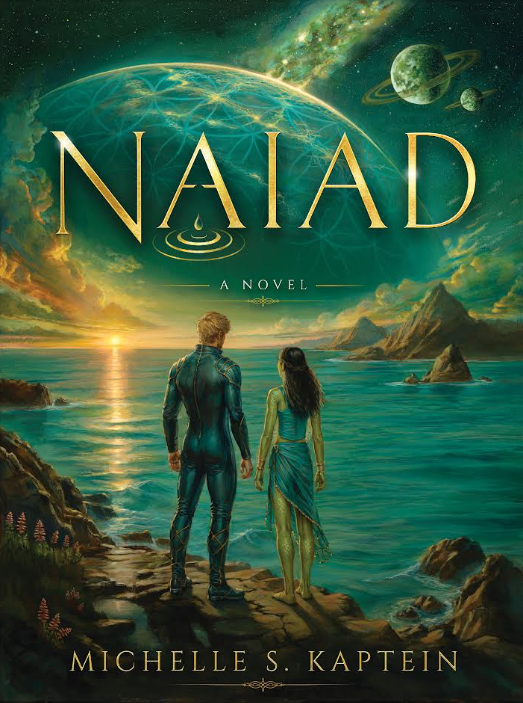
Two young people, separated by worlds and by very different lives, find their futures tied together in Michelle Kaptein’s Naiad. This young adult science fiction and fantasy novel sets its personal coming-of-age journeys against a larger question: what happens when a society plans to move its people to another planet, and the people involved begin to uncover dangerous secrets?
Set in the 23rd century, the story follows Jaxen, a genetically enhanced teenager on Earth, and K’ala, a young woman on the ocean planet Naiad. Their alternating perspectives give readers a view of both sides of the growing conflict. That structure suits a story where the worlds’ differences matter as much as the connection between its two leads: readers can see how each character’s home, expectations and discoveries shape their response to what is unfolding.
Two worlds with different pressures
Kaptein gives Earth a future marked by environmental damage and deep inequality. Advanced technology, including energy domes, helps define the setting and adds an unsettling edge to daily life. These details do more than signal a distant era; they suggest a world where survival and opportunity are unevenly shared. For Jaxen, that backdrop makes the question of who gets to decide his future especially immediate.
Naiad offers a sharp change of scene. Its ocean environment, marine life and underwater communities give the novel a vivid setting, while spiritual traditions distinguish the planet’s culture from Earth’s. The contrast gives the relocation plan extra weight: the story brings two societies into contact, each with its own way of living and understanding the world. Readers who enjoy imaginative settings will find that the planetary divide is central to the book’s appeal, rather than just scenery around the characters.
The two settings also give the novel room to consider how people respond when another society enters their lives. Kaptein’s descriptions invite readers to picture the underwater world and its communities, while Earth’s technology and unequal conditions create a different kind of tension. The resulting contrast gives the story a broad canvas without losing sight of the young people trying to make sense of their place in it.
Jaxen and K’ala’s separate journeys
Jaxen’s confidence sits alongside grief and a strained relationship with his father. He wants to make his own choices, but his path involves examining assumptions he has carried and learning when to trust others. That development gives his independence more texture: asserting control over the future is only part of his challenge, and the people around him complicate how he sees the choices ahead.
K’ala, meanwhile, is trying to understand her abilities and the obligations that come with them. At first, others don’t take her seriously. Her determination to protect Naiad gradually strengthens her confidence, making her growth closely tied to the fate of her home. The two protagonists therefore face different forms of pressure. Jaxen is wrestling with family and personal agency; K’ala is working out how to use her abilities and earn recognition.
Their developing relationship gives those individual arcs a point of connection. Readers can watch their perspectives shift as they encounter each other’s worlds and reconsider what they thought they knew. Kaptein keeps the focus on their growth while linking it to questions of trust, purpose and responsibility. The characters’ personal decisions carry added meaning because they unfold alongside a conflict that could affect both planets.
Mystery, pace and reader fit
Secrets provide a thread of suspense through the alternating viewpoints. An ancient prophecy is among the mysteries the characters must contend with, and the accumulating questions can help keep younger readers turning pages. The book combines those unknowns with character development, giving the story both a wider puzzle and emotional stakes rooted in Jaxen and K’ala’s choices.
There is a learning curve, though. The amount of world-building and specialized terminology may feel dense for some younger readers, particularly those who haven’t spent much time with science fiction. The technology and the two societies ask readers to absorb new details as the plot develops. Readers who enjoy building a picture of an unfamiliar world should find plenty to engage with; those looking for a lighter introduction to the genre may need more time to settle into Kaptein’s terms and setting.
Naiad brings fantasy elements and futuristic science fiction together in a story about choosing a direction, accepting responsibility and finding purpose. Its strongest draw is the interplay between two distinct worlds and two young characters whose growth is bound to what happens beyond their private concerns. For readers drawn to character-led speculative fiction, Kaptein’s novel offers an imaginative setting, an unfolding mystery and two journeys worth following as their consequences come into view.