Alysandra Dutton Reframes Rome’s Founding Myth in The Stolen Women
| Shelf | Book Reviews |
|---|---|
| Date in | |
| Readers | 831 |
In her debut novel, Alysandra Dutton follows Safinia through a mystery that questions who gets to shape history—and what those stories conceal.

Alysandra Dutton’s debut novel, The Stolen Women, revisits the story of the Sabine women with a pointed question: who benefits when a violent myth is softened into a tale of abduction, or even romance? Dutton builds her answer around Safinia, a brawler in the town of Sabinum whose immediate priority is keeping her sisters alive and fed. When young women and girls from the town begin disappearing, Safinia sets out to find them. Her guide is Livy, the real-life Roman historian recast as a time traveler. What he helps uncover draws Safinia and her people toward war with Rome.
The novel combines a mystery’s forward pull with a challenge to the stories told about Rome’s beginnings. Dutton spoke with Emily Mirengoff about research, historical invention, religion, gender, and the suspense that can survive even when readers know the myth’s broad outline. The interview has been edited for length and clarity.

Who gets to write the past?
Livy appears in the novel’s prologue, in a scene with Augustus, the first Roman Emperor. The two agree on what Rome’s foundational story should be. Dutton added that opening late in the writing process, though Livy himself had been part of the story from its earliest conception.
For Dutton, the historian is a character who can voice a familiar defense of Rome’s glory directly to someone harmed by it. Livy argues that Safinia’s suffering and the pain of her loved ones are worthwhile because they contribute to Rome’s greatness. Safinia rejects that reasoning. The confrontation lets the novel test grand historical claims against the lives they leave out.
The prologue also gives the book a circular structure. Its events take place after the main story chronologically, so reaching the end changes how readers may understand the beginning. Dutton describes this effect as a form of historical time travel: the past can be reconsidered when new context changes what a story seems to mean.
That question of context reaches beyond the novel’s structure. Dutton is interested in how an account of the Sabine women became so thoroughly softened that museum descriptions can suggest the women were merely kidnapped, perhaps without much objection. Her novel restores the violence at the heart of the story and asks how its gentler versions came to dominate.
Emily Mirengoff
Livy says, “I’m a historian. I get to write my own rules.” How did you develop him, and why introduce him before Safinia?
Alys Dutton
Livy was there from the earliest conception. There’s a lot of rhetoric about how glorious Rome was. When someone mentions the war crimes or chattel slaves, people claim it was all worth it. I wanted someone shameless enough to make that argument to someone directly affected—Safinia. Livy basically tells her that everything she and her loved ones endure will be worth it because it gives us the greatness of Rome. She doesn’t agree.
Introducing him in the prologue was a late decision. He’s speaking with Augustus, and they agree on Rome’s foundational myth. The scene is both the beginning and the end: it starts the events of the book, but chronologically it happens afterward. I wanted readers to reach the end, turn back to the beginning, and see it differently. That’s the real time travel historians do: contextualizing and recontextualizing.
Research in the details
Dutton’s historical research supplies the material texture of daily life, from what people used as toothpaste—ground oysters and bone grit—to the construction of a hut. She found the toothpaste detail in Roman archaeology. The archaeological record for ancient Sabinum, where the novel takes place, is sparse, so she reasoned that some everyday practices could have crossed between neighboring cultures.
Her research took shape during her master’s program at the University of Arkansas. Through an international fellowship, she joined the awards cohort at the British School at Rome. For three months she worked in its library, drawing on books and materials she would not have known to search for on her own. Lectures by visiting scholars and archaeologists added further direction. One program director pointed her toward the Forma Italiae series, whose volumes describe excavations and the objects uncovered at historic sites. Dutton used Google Translate on her phone to work through the Italian text.
All that material initially made the manuscript enormous. The first version she sent to her agent ran to 145,000 words; the published version is 110,000. While in Rome, Dutton gave herself permission to include every discovery. Later, she had to decide which details served the story and its argument. She had spent a day studying hut construction, for example, only to conclude that the novel needed to say the hut was made of mud.
Emily Mirengoff
How did you shape the religious beliefs of Safinia and the other characters?
Alys Dutton
I studied comparative religion as an undergraduate, until my small, struggling college cut the major. Then I switched to creative writing. Roman religion is tricky because Hellenism spread through Europe around the third century BCE. Roman gods became attached to Greek counterparts, such as Diana to Artemis, but Roman religion was its own thing. The gods don’t map neatly onto Greek ones, and before Hellenism they weren’t personified in the same way. The idea of gods walking onto a battlefield and arguing over who would win wasn’t really how Romans thought about them.
Some scholarship from more than a century ago led me to animism, which helped me imagine the worship of Feronia, the woods god Safinia follows. I chose Feronia partly because other Sabine goddesses, including Diana and Minerva, are often muddled in popular imagination with their Greek counterparts. Feronia doesn’t have a Greek equivalent, so she gave me a way to make that distinction.
Gender, queerness, and contemporary speech
One of the novel’s gay male characters encounters homophobia expressed through a belief that a man who takes a woman’s sexual role lowers himself. Dutton uses Safinia’s questioning nature to examine that logic. She acknowledges that there is no historical record of someone expressing the idea in precisely the terms used in the novel. Her aim is to ask why this particular form of homophobia existed in ancient Mediterranean cultures, writing through a feminist lens about people subordinated because of their gender.
For Dutton, naming a cultural norm is a first step toward challenging it. She expects some readers to question queer characters in ancient settings, given that evidence depends partly on how ancient texts are interpreted. But the novel’s inquiry is deliberate: Safinia keeps asking why, and the book uses her questions to examine what gendered assumptions may underlie the treatment of queer people.
Dutton also chose naturalistic dialogue to keep the characters close to contemporary readers. Some historical novelists use what she calls a Homeric effect, creating a mythic distance she admires in Madeline Miller’s work. Dutton wanted a different register because the questions in her book—especially those about control over women’s bodies and reproductive systems—feel immediate to her.
There is no reliable model for how Paleosabellic sounded, Dutton says, and she didn’t want to invent a formal, supposedly ancient mode of speech. That could add artifice to a story questioning the ways history gets glorified. People speak casually across cultures and periods; Livy is the exception. Dutton gives him a loftier manner because he is the character constructing a grand historical account.
Suspense with a known destination
Dutton has been preoccupied with the Sabine story for ten or fifteen years. Its treatment in art has been part of that interest, including Luca Giordano’s The Abduction of the Sabine Women at the Art Institute of Chicago, which inspired her. She is frustrated that a prominent modern retelling is Seven Brides for Seven Brothers, the frothy romantic comedy from the fifties.
The myth’s name gives away the broad shape of the story, but Dutton sees that foreknowledge as a source of suspense. At the Bread Loaf Writers Conference, Peter Ho Davies introduced her to the term “posthumous irony”: knowing what will happen can make readers more eager to learn how it unfolds and who survives. Dutton’s task, as she sees it, is to make readers care about the characters enough to fear for them across 400 pages.
The Stolen Women by Alysandra Dutton is published by Park Row on October 27, 2026.
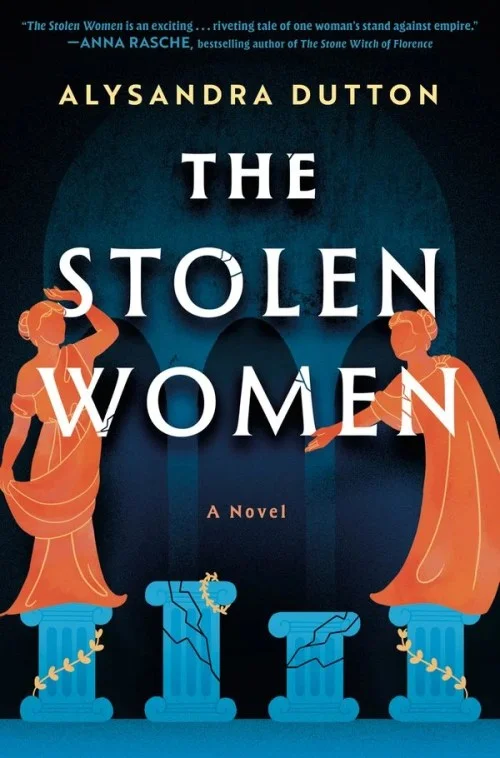
FICTION
The Stolen Women
By Alysandra Dutton
Park Row
Published October 27, 2026

The book’s central tension sits between the lives Safinia is trying to protect and the sweeping story Livy wants Rome to tell about itself. Dutton’s research lends that conflict historical texture, while her mystery structure keeps the question of what happens to the characters firmly in view.