Cash, Home and Second Chances in Keith Pilapil Lesmeister's Iowa
| Shelf | Authors & Interviews |
|---|---|
| Date in | |
| Readers | 761 |
Keith Pilapil Lesmeister's Ask Me About the Money follows Iowa drifters and grifters for whom every dollar matters and every home feels provisional.

Money is the pressure point in every story in Keith Pilapil Lesmeister's second collection, Ask Me About the Money, and that's what makes it worth a close read. The book covers characters desperate for cash, connection and a chance to start over. Drifters and grifters are either searching for home or running from it, and the young narrators keep hoping while the adults around them let them down, again and again. The result is a collection about rural Iowa that doesn't need a map to feel specific.
Think of Mato, a railway worker who keeps losing at the blackjack table. Or Ronald Driver, an unwelcome houseguest who bullies a mother and son in a home he refuses to leave. These characters don't come across as types. They come across as people whose bank balances have shaped every decision they've made. Lesmeister's stories are set in and around the Driftless Region near Cedar Rapids, and the flat, practical texture of that part of the state runs through every page.
Critics have already taken notice. David Gates called Lesmeister a "heartland Chekhov," and Andrew Porter described him as "one of the most exciting and talented short story writers out there." Those are big claims, but the stories earn them. The collection is also the second to come from a writer who has been building a clear and consistent body of work.
Money as the spine of the collection
The interview with Amber Wheeler Bacon opens on the idea that money keeps showing up in the book's most revealing moments. In "Copper Nugget," a six-year-old narrator describes how the mention of money always set off a question from his grandfather, who wants his grandson to spend wisely. That small exchange sets the tone for the whole collection.
Lesmeister says he didn't plan a book about money. It emerged from the work. He'd been publishing stories for a while, and when he looked at them together, money turned up in nearly all of them. "Copper Nugget" and a few of the shorter pieces were written specifically for the book, and he thinks of those shorter pieces as interludes more than stories. That distinction matters. The interludes act like connective tissue, so the collection reads as a sustained inquiry rather than a loose grouping of stories.
What's striking is how that inquiry splits along generational lines. The grandfather's anxiety about spending gets set against a narrator who sees money as almost meaningless, a grain of salt in an endless ocean. Meanwhile, in "Fighting for Scraps," another narrator measures his father by how he treats his belongings. The two attitudes sit side by side without resolving, and that tension is the point.
Work, wealth and what Lesmeister believes
Lesmeister's own relationship with money is more hands-on than most writers' would be. He has worked since childhood, first alongside his father on trips to the scrapyard and on construction sites, including weekend side jobs. Later came yard work and driveway shoveling for neighbors, then detasseling corn, which is a rite of passage for many Iowa teenagers. His first real job was at a Hy-Vee grocery store.
As a kid, he says, money didn't carry a moral weight for him. It meant freedom, the ability to buy a pair of shoes or a new CD and spend the rest however he liked. It was a means to an end. Now he sees it differently. He argues that how a society positions itself around work and money is a moral question, and he doesn't hedge on it. His example is people with serious illnesses, like cancer, who have to hold fundraisers to pay medical bills in a country with so much wealth. He calls that morally reprehensible.
He also takes aim at billionaires, arguing they avoid paying their fair share in taxes while drawing on the same system that made their fortunes. In his view, a country can't sustain fewer people accumulating more and more, and he says fewer than 1,000 billionaires own close to 60 percent of the nation's wealth. These are his views, not a neutral policy argument, and he's upfront that the subject gets him riled. Read them as the convictions of a writer who has lived the economics, not as a verdict on the economy.
Cash, crypto and an antique-store feeling
Bacon points to a sharp contrast: the abstract wealth of billionaires against the money in these pages. Coins, a voided check, a bag of cash. These are things you can hold. In an era of cryptocurrency and day trading, where money feels real only once it's cashed out, the physical currency in the stories has an almost archaic quality. Reading the book, Bacon says, felt like walking through a row of antique stores.
Lesmeister's answer is simple. Where he lives, cash is still king. He pays cash at locally owned boutiques and groceries, and he barters and trades when he can. He calls it a small but meaningful protest against a culture that loves its so-called capitalist system, and he adds a pointed comment that the country's economy looks more like socialism-light than pure capitalism. He admits he doesn't have Apple Pay on his phone and only recently figured out how to tap a credit card. Those details aren't a bit. They're the texture of his daily life, and they show up in his fiction.
That texture matters for a reader. The nostalgic objects in these stories aren't decorative. They reflect a world where a handful of bills changes what a person can do that day.
Desperation and the logic of a character
The conversation then moves to "I'd Help if I Could," which centers on a character who needs fast cash. Bacon, who has been rereading Jane Austen while new adaptations are in the works, notes that Austen's novels are also about money, and how a question of finances can strain every relationship in a family. Lesmeister's approach is more direct. "Desperate people do desperate things," he says, and he admits the line is a cliché. Still, the logic holds. Liz knew early on that she would do something drastic. It wasn't about harming anyone. It was about getting the cash, and she saw one clear path and took it. For readers, that's the unsettling part of the story: the choice seems inevitable from inside her situation, even if it wouldn't be from outside it.
Influences and the shelf they sit on
Bacon mentions Lucia Berlin's A Manual for Cleaning Women and Denis Johnson's Jesus' Son as books that came to mind while reading. Lesmeister has read both and loves them. Over the past couple of summers, he's gone back to the early work of Raymond Carver, whose stories are full of people struggling in jobs and relationships. Carver was an early influence, and his working-class characters still matter to Lesmeister. That lineage makes sense. Carver, Berlin and Johnson share an eye for hardship that never turns into self-pity, and Lesmeister seems to be working in that same tradition.
Rural decline and the question of home
Bacon asks how the economic pressures of the past few years, including tariffs and rising prices, have affected Iowa towns like the ones in these stories. Lesmeister's response is less about headlines and more about the slow decline he watches every day. He describes a strange mix of sadness and fascination with the people who keep living and working in rural Iowa as though nothing were wrong. Some still seem to believe the state will bounce back from the farm crisis of the 1980s, or that people will leave cities for small towns in large numbers.
His figures are blunt. He says 99 percent of rural Iowa towns are shrinking, and he expects that decline to speed up as the baby boomer generation retires. He doesn't claim to have a solution. He says he watches with both fascination and dread, and that every bit of it feeds his writing.
Home is the other pillar. Bacon notes how often characters in Ask Me About the Money live in motels, sleep on couches or crash with friends, while homeowners renovate attics and basements and boys spy on a family moving into a new house down the street. Lesmeister says he's obsessed with how people maintain and protect their home spaces. A visitor who doesn't belong, or a neighbor who turns home into a target for insults, creates immediate conflict. What happens next depends on how a character responds, and how much a fragile, temporary home can take. That tension, he says, is what moves the story forward.
Race, rural life and the anthology
Lesmeister also edits an annual collection for Eastover Press, An Anthology of Rural Stories by Writers of Color, and his fiction keeps returning to working-class, small-town Iowa. Bacon points out that rural America is often portrayed in popular culture as uniform, and asks what draws him to the intersection of race, rural life and class. His answer comes from experience. He suspected that if he was being treated as an outsider in his hometown, other writers of color in rural places were probably dealing with the same thing. He lists the familiar questions: "Where are you from?" or "Do you speak [insert language]?" He recalls one remark, made when he wore a ponytail, that asked whether he was trying to say he wasn't Lakota.
Living in a small town is good, he says, but parts of it put him on edge, and that friction can produce strong fiction if the writer handles it well. The anthology grew from that idea. He wanted to hear how other writers reflect their own experiences on the page.
Strangers, drifters and the worst-case exercise
Bacon's favorite stories turn out to be classic "stranger comes to town" tales. Even when a central figure isn't new to a place, the stories often make it feel as though they are. Ronnie, the antagonist of "Fish and Rice," is a particular pleasure to hate. Bacon also describes the collection as both an ode and an elegy to vagabonds, full of people looking ahead to their next job or glancing back to cover their tracks.
Lesmeister, who describes himself as someone who works hard not to disappoint people, laughs off the idea that he's a drifter at heart. He says he's had his moments, and he knows people who've had plenty of unsavory ones. His method came from a Bennington mentor, Bret Anthony Johnston, who told him to write what he doesn't know. Johnston's prompt was to start with a worst-case scenario, barring war or global economic or environmental collapse. Lesmeister settled on addiction and estrangement from family, the kind of slide that a couple of wrong moves could make real. Several stories in the book come from imagining that slide happening to him.
That's the most useful thing in the interview. It explains why the drifters and grifters feel so close: they're built from fear, not fascination. The reader gets characters who could be anyone, and the book is better for it.
For readers, the book's pleasures are clear. You get sharp, unsentimental stories about people short on money and long on hope, set in a part of the Midwest that most fiction skips. You get a writer with strong opinions, admitted candidly. And you get a collection that gets more interesting the more you notice how money and home keep leaning on each other. Ask Me About the Money is published by Cornerstone Press on November 3, 2026, and it's worth putting on the list now.

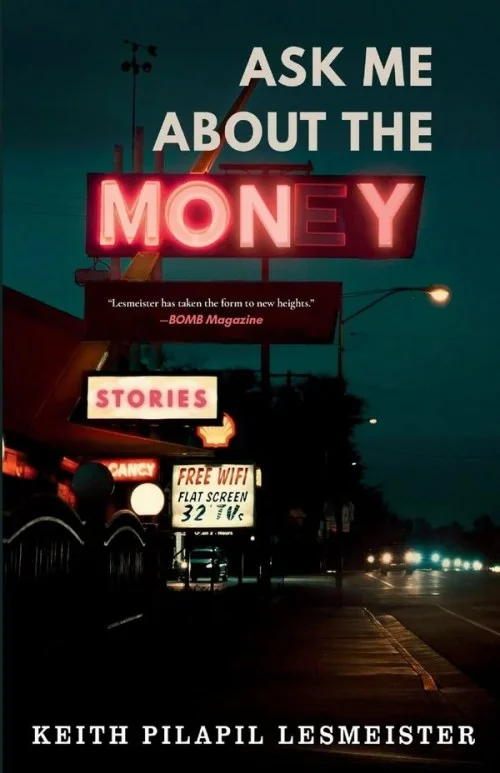
FICTION
Ask Me About the Money
By Keith Pilapil Lesmeister
Cornerstone Press
Published November 3, 2026