Marlon James's The Disappearers Asks What Revenge Actually Repairs
| Shelf | Book Reviews |
|---|---|
| Date in | |
| Readers | 489 |
Two critics weigh Marlon James's 650-page Jamaica-set novel on violence, revenge and the gay experience, and whether its sky-high praise holds up.

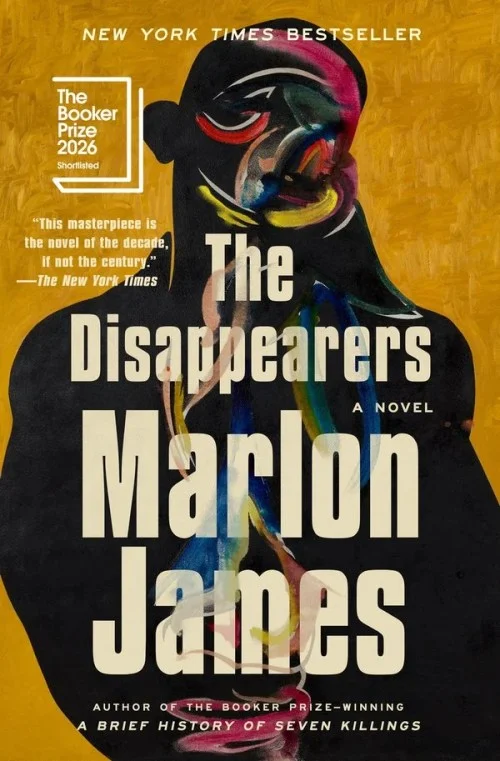
Dwight Garner's New York Times review opens with a line that works as both warning and endorsement: "You don't finish The Disappearers. It finishes you." His headline goes further, calling the book "the novel of the decade, if not the century." Verdicts that sweeping usually take years to earn, which is part of why this one drew so much attention. It's a violent, 650-page novel full of graphic sex, and it arrived with the kind of buzz that makes readers suspicious. So the real question is whether it earns the claim.

Riverhead Books publishes the novel on September 1, 2026. It's Marlon James's first non-fantasy novel since A Brief History of Seven Killings (2014), which was itself widely lauded. This time he returns to Jamaica to tell the story of gay life there in the late 1980s and 1990s. The book is about homophobia, violence and revenge, and it runs on a rage that stays hot from the first page to the last.
Did the hype hold up?
Michael Welch, editor-in-chief of Chicago Review of Books and a longtime James devotee, admits he hesitated before starting. He loves Seven Killings and didn't want to be let down. His verdict is that the new book lives up to its reputation and may be James's magnum opus, even if Seven Killings stays his personal favorite. He describes James's voice as distinct and powerful enough to pull him back in immediately.
Greg Zimmerman is more cautious. He thinks it's far too early to crown any novel the best of the year, let alone the century. He's happy to call the book very, very good, and he says it surprised him, which is hard to do with a reader who has seen as much as he has. But he's not sure he enjoyed it. "I feel like I survived it," he says. That's a useful distinction for anyone deciding whether to read it. Admiration and pleasure are different things, and this book asks for the first far more than the second.
What the reading asks of you
Welch's account of the reading experience is the most practical one here. James writes in a style that's conversational, digressive and steeped in Jamaican dialect and the cultural references of its era. Early on, you may wonder whether you're keeping up. Then, for Welch, there's a moment when it clicks and the prose starts to feel like poetry, even when the material is brutal or the narration is cracking jokes. He argues that the demand James makes of readers suits the subject. The book wants you to sit with its characters' experience, "in all their beauty and violence," across years and silences.
Zimmerman adds that the difficulty is both formal and thematic. The novel deals with violence against gay men, homophobia, AIDS and suicide, and it doesn't soften any of them. He points to James's own remark in an interview that he counts himself lucky not to be a character in one of his novels. That joke lands differently once you've spent several hundred pages with the people it describes.

Revenge at the center
Zimmerman's central reading is that, under the rage and the shame, this is a novel about revenge. He treats rage and shame as two sides of the same coin, and both show up in violent, haunting forms throughout. The novel is polyphonic, but if there's a protagonist, it's Jordan Brown, who is one of the victims of the attack that sets the story moving. Later he says his inspiration for revenge comes from a subplot in Toni Morrison's Song of Solomon, in which a group of Black men take justice into their own hands as they see it, in response to violence against their community.
James himself addresses the theme in an interview with Stephen Patrick Bell for Chicago Review of Books. "The thing about revenge, they're right about it being a dish best served cold," he says. "My characters, even after they've gotten revenge, still have to deal with the emptiness of the life that made them seek revenge in the first place. That revenge restores nothing. It repairs nothing." Zimmerman finds that line profound and brilliant, and also "impossibly sad." That's the emotional key to the book. It doesn't offer a payoff. It shows what's left after the payoff, and that's harder to read.
Why it became an event
Welch sees the commercial success as evidence that book marketing still works. A novel this unsparing isn't an obvious bestseller, and yet it has moved into a wider conversation. He suggests that enough resources, supporters and strong writing can still push a book into public attention, and he worries that fewer titles get that kind of push now. Zimmerman credits something simpler: a Marlon James novel is an event, and James is a magnetic figure whom readers, critics and tastemakers rally around.
Welch argues that a "literary event" usually has an element of grandness in its subject, scope and time span. The Disappearers qualifies. It covers the long history of violence, shame and silence in Jamaica, but it also speaks to the gay experience more broadly, across decades and continents. He compares its reception to Hanya Yanagihara's A Little Life, which became a social media sensation while readers kept saying some version of "this is great and also the most upsetting thing I've ever read." Zimmerman agrees the comparison is apt, down to the sense of being emotionally worn down. Welch's take is that difficult books deserve readers who are willing to be stirred up.
Where it sits on the shelf
Zimmerman offers three comparisons: William Styron's Sophie's Choice, which he calls possibly the saddest book ever written; Cormac McCarthy's Blood Meridian, one of the more gratuitously violent books around; and Percival Everett's The Trees, which is also traumatic but very funny. Each one hints at a different part of James's range, from grief to brutality to dark humor.
Welch is more hesitant about comps but offers a few anyway. He connects the critical response to Colson Whitehead's The Underground Railroad, a compelling read with some of the most painful moments in recent fiction. He thinks of Richard Wright's Native Son, which also shows how social inequity can close in on a character. And he points to Dostoevsky's Notes From the Underground, because Jordan's sections trap you inside a narrator's head, with his language tightening as the cost of his revenge becomes clear.
What Welch values most is James's boldness. He describes one novel about the attempted assassination of Bob Marley, partly narrated by ghosts, in which the crime doesn't happen until about three-quarters of the way through. He mentions a high fantasy series built on African mythology, where each book retells the same story in parallel. And he points to a earnest, heartbreaking saga about men bound to one another even as they're scattered. Welch's conclusion is that few writers would attempt these structures, and he's convinced only James can pull them off.
FICTION
The Disappearers
By Marlon James
Riverhead Books
Published September 1, 2026
If you're deciding whether to read The Disappearers, go in knowing what it costs. Welch hopes readers will take on its difficulty rather than retreat from it. Zimmerman, who admires it more than he enjoyed it, would tell you to plan for an experience you'll need to recover from. Both agree it's the kind of book that changes the reader, and both agree its answer about revenge is grim. The more interesting question is what the next wave of readers and critics makes of a novel that has already been called a masterpiece before anyone has had time to live with it.