All's Well in Jingle Valley Ties Up Old Threads Without Closing the Door
| Shelf | Book Reviews |
|---|---|
| Date in | |
| Readers | 783 |
Martha Reynolds' women's fiction sequel resolves April and Bill's romance and Julie's search for family. It rewards readers who have followed the series from the start.

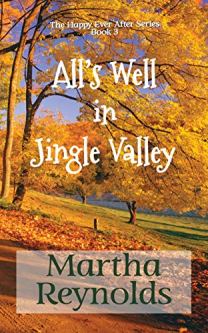
Readers who have followed Jingle Valley from the beginning will find this one feels less like a standalone and more like a homecoming. Martha Reynolds' All's Well in Jingle Valley is a women's fiction novel that picks up the story threads left open in A Jingle Valley Wedding and April in Galway. The other books in the series work on their own, but this one rewards the reader who has been there for both.
Where the story lives
The book follows two connected arcs. Julie wants a relationship and a family of her own. Meanwhile, Freddy is raising an adopted son with his husband, Bob. Running alongside those lines is the resolution of April and Bill's romance, which moves toward a wedding at Jingle Valley. None of these people get an easy path. Grown children, parents who have opinions about everything, and a past that refuses to stay buried all push back against what they want.
What I appreciated is how much ground Reynolds covers without the book turning into a checklist. Readers get updates on nearly everyone they met earlier in the series, but the author stops short of tying every bow. Plenty of questions stay open. That gives the novel the feel of one chapter in a longer life rather than a sealed ending, and it leaves room for the series to pick up again if Reynolds chooses.
Freddy steals the room, but not the book
Freddy is the character readers are likely to remember. He brings humor and a sense of style to scenes that could easily sink under worry. The risk with a personality like his is that he becomes the book's engine and everyone else becomes scenery. Reynolds avoids that. Freddy gets his own problems here, and those problems push him to grow alongside the other leads instead of simply lightening their load.
The other principals each get a turn to show how the years have changed them. The characters read as continuations of their earlier selves rather than reinventions, which matters in a series where readers have spent several books getting attached to them.
The brother who fades out
Thomas is the notable absence. He was a central figure in A Jingle Valley Wedding and gets barely a mention here. For a reader who cared about him, that silence is noticeable. If this is meant to be the last word on the series, a few paragraphs on how his life has turned out would have closed a gap that the book leaves visibly open. Still, the novel is already juggling a lot, and it's easy to see why Reynolds might have decided his thread could not fit without crowding out someone else. I'd still have liked a sentence or two.
Description that follows the mood
Reynolds has been expanding her descriptive writing as the series has gone on, and this book carries that forward. The weddings and the settings come through in rich detail, and that detail shifts with the characters. When someone is absorbed in their own worries, the prose narrows and gets spare. When they're paying attention to the world around them, the scenery fills the page. It's a small craft choice, but it keeps the writing tied to the people experiencing it.
Convenience and foreshadowing
Not everything lands cleanly. Julie's exploration of adoption feels a little too smooth, at least where older school-aged children are concerned. The process is presented as more straightforward than many readers will expect, and that's the moment where the realism wobbles. Elsewhere, the story is carefully set up. Several threads are foreshadowed well enough that their payoffs feel earned rather than arbitrary. The emotional scenes carry real weight, and the drama is measured so it doesn't tip into melodrama. Some of the emotional beats are the best writing in the book.
Who should pick it up
This is a strong pick for readers who want to spend time with characters they can return to. The people here feel real, and their struggles, including family strain, parenthood and second chances, read as genuine and current. Anyone who started the series for the friendships and the small-town warmth will find plenty to enjoy.
My advice: start with A Jingle Valley Wedding and April in Galway. You'll get far more out of Freddy's household, April and Bill's history, and Julie's ongoing hopes if you know where they've been. Newcomers can enjoy the earlier books on their own, but this one is written for people who are already invested.
The book leaves readers wanting more, which is an unusual compliment to give a novel that has just resolved so much. Whether Reynolds returns to Jingle Valley or not, the ending points toward lives that are still moving, and that's the best sign a series can give.