Joshua Corey on Identity, Masculinity and The Last Words of Jack Ruby
| Shelf | Book Reviews |
|---|---|
| Date in | |
| Readers | 548 |
Joshua Corey discusses the layered stories, Jewish identity, boxing and research behind The Last Words of Jack Ruby.
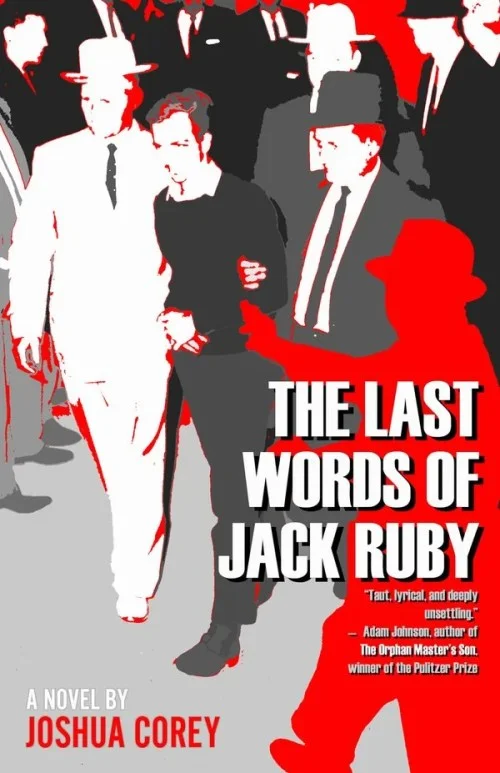
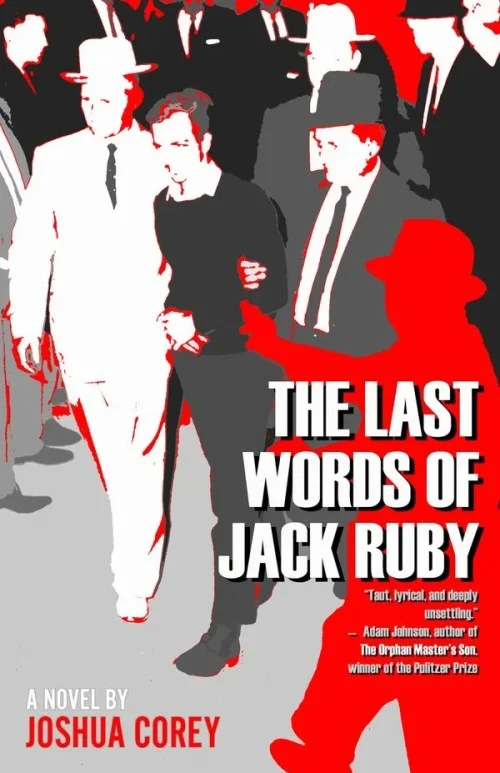
Joshua Corey’s The Last Words of Jack Ruby takes a familiar historical mystery and turns its focus toward a less familiar question: what does one man see in another that he wishes he could become? Jack Ruby, dying in a hospital room, is meant to answer questions from FBI agent Jon Bergman about the secrets around the Kennedy assassination and Ruby’s killing of Lee Harvey Oswald. Instead, Ruby keeps talking about Barney Ross, his friend from Chicago: a Jewish boxer, war hero and public figure whose life seems to offer Ruby a model of manhood and success he can’t attain.
That fixation sends Bergman through a noir shaded Dallas of shady hotel workers, cab drivers, prostitutes and rogue agents. The more he tries to interpret Ruby, the more he is pulled into Ruby’s private mythology and his own unresolved questions. Corey’s novel moves among historical lives, invented characters and a story about the Golem of Prague. Its many strands circle identity, luck, faith, fear, love and the gap between the person someone hopes to be and the person others see.
Corey says the novel didn’t begin as a story about Ruby. For years, he heard accounts of Barney Ross from his late cousin Al Rasof. Corey was struck by the contrast between his own bookish, unathletic life and Ross’s story, and by the boxer’s improbable appearances across different settings: Prohibition Chicago, Guadalcanal, the Rose Garden, the Irgun and Ruby’s trial. Ross’s connection to Ruby became the spark.
Ross remains the novel’s structural backbone, but Corey chose to tell his story through Ruby’s eyes. In Corey’s imagining, Ross is more than an old friend: he embodies a life Ruby wants. The two men share poor, working-class Jewish backgrounds, yet one becomes famous and the other infamous. Corey leaves the question of why they diverge alive inside the novel. Was Ross braver, tougher or kinder? Did faith help him, or was luck decisive? None of those explanations satisfies Ruby for long.
Stories nested inside stories
That uncertainty is echoed in the novel’s form. Corey struggled for years to connect scenes and chapters he valued, while Ross’s life offered more material than one book could hold. Once he placed Ruby at the center, the interrogation gave him a frame. Bergman then had to become a full character, rather than a device for drawing out Ruby’s story. The Golem narrative adds another layer, reflecting on the three central men without crossing directly into their lives.
Corey says the shape emerged when he saw how the separate narratives could lead to the ending. The result works like a set of Russian dolls: each story opens onto another, and each character’s questions illuminate someone else’s. Ruby wonders why Ross became the man he admired; Bergman confronts the mystery of Ruby; the Golem story offers a parallel lens on their journeys.
Jewish identity binds these strands, though Corey resists treating it as a settled category. He describes uncertainty about what Jewishness means, what it asks of a person and what a Jewish man is permitted to be as part of the subject itself. Ross, whose devout father was killed in a holdup, turned away from religion before returning to it. Bergman was raised Lutheran, though his mother is Jewish, and the case draws him toward a heritage he has only partly claimed. Ruby, after his arrest for killing Oswald, said, “I wanted to show that Jews have guts.”
The novel also follows the pressures that shape Bergman’s sense of self. Its opening line, “Bergman looked the part,” introduces a man whose appearance seems to fit his profession: tall, blond and athletic. Inside, Corey says, Bergman is in turmoil. He wants the purity of purpose he associates with his FBI identity, while his Jewish background makes him vulnerable within an organization Corey describes as hostile to Jews, Black people and Communists.
Corey’s account of J. Edgar Hoover’s FBI is that it operated like a cult, with Hoover’s preferences shaping who could join and advance. Hoover understands Bergman’s unease and uses it to make him the instrument he needs to interrogate Ruby. Bergman believes in America and fears that unanswered questions around the assassination could damage the country’s sense of itself. He wants to resolve the mystery and become its hero; Hoover’s aim, as Corey describes it, is to silence Ruby. The case therefore tests Bergman’s identity as much as his ability to investigate.
Consolation, manhood and bad luck
For Corey, conspiracy thinking offers a kind of comfort. It turns helplessness into the feeling of possessing privileged knowledge: events may have made you a victim, but you can at least imagine that you know who arranged them. The appeal, he says, lies partly in the wish to feel savvy and separate from people who are supposedly fooled. That wish can leave people ready to hand their judgment to someone else.
Ideas about masculinity work in similarly uneasy ways across the novel. Corey sees Ruby as a precursor to today’s online purveyors of manhood and self-improvement. Ruby ate health food when he wasn’t indulging in pastrami, exercised, used speed to manage his weight and promoted devices such as a twist-board, which promised a slimmer body through gyration. His sexuality was ambiguous to him, and he repeatedly asked others whether he seemed gay. He had a longtime fiancée but never married her. Corey leaves open what the relationship meant to Ruby’s sense of how a man should appear.
Those tensions have a specifically Jewish dimension in the novel. Corey points to the earlier “muscular Judaism” movement, associated with Zionism, alongside longstanding stereotypes casting Jewish men as physically weak. Ruby reaches for a gun to settle doubts about his manhood, while Ross uses his fists and Bergman his badge. Corey’s assessment is blunt: the characters’ pursuit of masculine certainty tends to make things worse.
His boxing scenes grew out of personal experience. Corey doesn’t call himself a boxer, but about a decade ago he began training at Tier One Training in Evanston because he wanted to understand what it meant to throw and absorb a punch. As a child, he had been neither athletic nor aggressive and retained painful memories of being beaten up at school. In his mid-forties, he found himself training harder than ever. The gym’s atmosphere was not macho, and women trained there in numbers nearly equal to men. Corey sparred with younger men but never competed. He says the experience helped him feel newly capable in his own body, and he credits Ross with prompting the effort.
Research that feeds the imagination
The period settings are built from both firsthand exploration and reading. Corey visited the neighborhood where Ruby and Ross had lived, went to Dallas to see the site of the Carousel Club and stood on the grassy knoll. He read old newspapers and books about Jewish boxers and gangsters, alongside the Warren Report and a large number of Wikipedia pages. That accumulation gave him a sense of Al Capone’s Chicago, late-1960s Dallas, the Pacific theater of World War II and other places that enter the novel.
For Corey, research has to serve the imagination rather than crowd it out. He describes it as something that can consume all available writing time if left unchecked. A compliment about his first novel, Beautiful Soul: An American Elegy, helped show him what research could accomplish on the page. Much of that book takes place during the student rebellions in Paris in May 1968. Corey recalls his former boss Jack Goldman, a bookstore owner in Ithaca who had been there, reading the novel and asking how Corey knew what it felt like. Corey says he has remained proud of that response.
One of the novel’s wryest ideas arrives through a Jewish cab driver who explains the difference between a schlemiel and a schlimazel. In the classic joke, the schlemiel is the waiter who spills the soup; the schlimazel is the customer who gets splashed. Both are losers, but one causes harm through clumsiness while the other bears it. The schlemiel can stumble into insight by puncturing the schlimazel’s pretensions.
Corey calls Ruby the sadder figure, the schlimazel. Bergman wants to be a hero, as Ruby once did, but he must eventually choose which role he will occupy. Corey says the ending makes clear where the soup will spill. That image gathers the book’s larger concerns into a compact, comic measure: people may shape their identities, but they can’t always decide what history, chance or another person will make of them.
The Last Words of Jack Ruby by Joshua Corey is published by Tortoise Books. Its publication date is November 24, 2026.